NWP Monthly Digest | September 2026
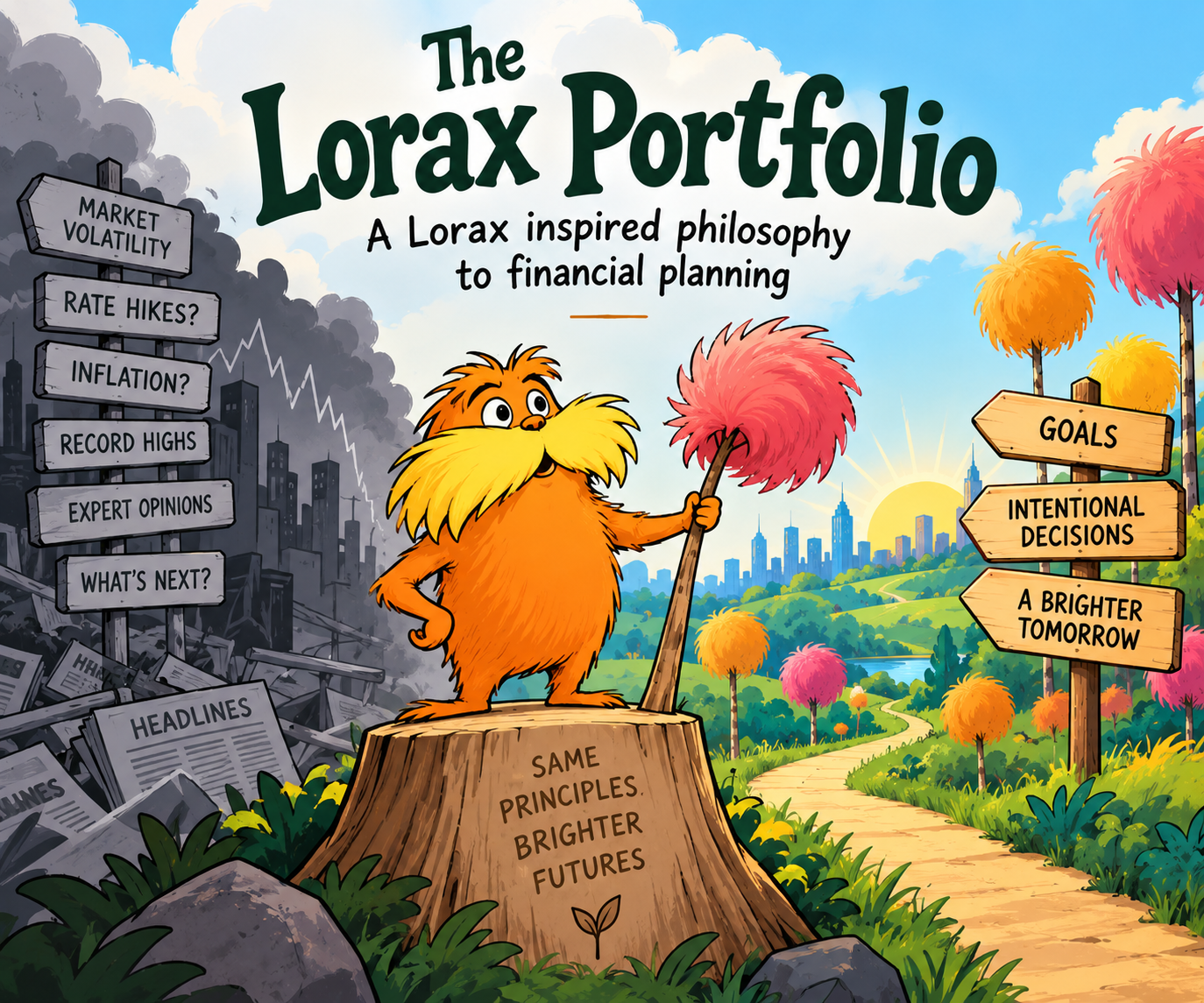
School is back in session, and so is Wall Street.
August delivered a bit of everything. The S&P 500 set new records early in the month, the Dow closed above 54,000 for the first time, and both drifted off those highs into month-end — though all three major averages still finished August higher. Kevin Warsh used his first Jackson Hole speech as Fed chair to talk about the work left to do on inflation, and futures markets swung from expecting nothing in September to roughly a coin flip on a rate hike. Long-term Treasury yields sit near multi-decade highs. With July's inflation data now available, early projections suggest next year's Social Security COLA could be around 3.5%. That's great news for beneficiaries, as it would mark the biggest increase since 2023, though the official figure won't be announced until October.
A year ago, the debate was how quickly the Fed would cut. Now it's whether the Fed will hike. The forecast changes. The plan shouldn't.
Which brings me to bedtime at my house.
Last week, I went through the bedtime routine with my youngest son and asked him to pick out one last book. As always, he picked The Lorax. I offered him several new books to choose from instead. He thought about it for a few seconds and said, “No, I want The Lorax.”
My kids often wonder what I do for work. Do they think my job is mowing the lawn, painting the house, fixing things? I'd really like to know. But it dawned on me that this was my opportunity to explain a large part of what I do for a living — or, at the very least, one of the tools I use to help my clients.
In my profession, choosing the same book we've read every night for the past two weeks is akin to the low-risk option with a predictable, defined outcome. Choosing one of the new books introduces risk: he may like it more, but it may also be the worst book he's read... or had me read to him😉
There are two sides to this analogy: our discussions with clients, and the internal decisions behind the scenes — how the sausage is made
Discussions With Clients
Here, our job is to help clients focus on their goals and pare their options down to the strategies that will get them there with intention. Certainty instead of randomness.
Plan Accordingly: The Future Is Unknown
A narrow range of outcomes is paramount in my profession, and there are thousands of ways to get there. One easy example is the decision of whether to collect Social Security early or at full retirement age instead of delaying until age 70. Sure, there are times when it makes sense to collect early, but typically that's not the case.
Instead of framing this decision around what is optimal and what maximizes a client's wealth, a better lens ties the decision back to the risk within a financial plan and the client's ability to accomplish their goals.
John:
John decides to delay his benefits until age 70. He's in normal health when he makes that decision, and he has other wealth or means to live off of until then. The break-even age, where a client would be indifferent between collecting at full retirement age and delaying until 70, is typically around 82 1/2, or closer to 84 once you discount those cash flows.
So what if John unfortunately suffers a heart attack at age 75? Sure, John likely did not get back what he's paid into Social Security, which is a common fear among clients. But during his life, did he accomplish all of his goals? Did he run out of money, or was the financial plan ever in jeopardy? If the answer to the first is yes and the second is no, then from a planning perspective, this is not something to worry about.
Instead of assuming John waits until age 70 to collect his Social Security benefits, let's assume John's beliefs or fears about Social Security becoming insolvent, not getting back what he's put into the program, or possibly passing away prematurely are insurmountable, and John decides to collect at full retirement age, or even early. And instead of passing away at 75, he lives until 95.
If John is somewhat reliant on that Social Security income, which can easily be $50K per year, the decision to collect early permanently reduces the amount he collects for the rest of his life. That might mean he has to supplement his income more than he otherwise would have, and it adds an element of the client running out of money earlier.
📌There's asymmetry when it comes to the risk within the plan. If John delays his benefits and passes away early, it's not a problem. If he lives longer than expected, he has a higher income stream to hedge longevity risk. But if he collects early and passes away early, perhaps it's still not a problem - and in the event he lives longer than expected, it poses real risks and widens the range of outcomes, especially to the downside.
Mr. and Mrs. Smith:
Same idea, different client. What if Mr. and Mrs. Smith earn close to $1M a year and just had children? Let's say that Mr. and Mrs. Smith just finished medical school, are buried in debt, and haven't had the opportunity to build wealth. Should one of them pass away, the lifestyle for the rest of the family is going to be very different.
So it probably makes sense to have life insurance, or even disability insurance, to hedge against that risk until the assets are at a level where this is no longer a significant risk in the plan.
Sure, if life insurance is not purchased and those premiums are instead invested, and there is no premature death, wealth at the end of the plan will be significantly higher. But in the low-probability event that something were to happen, the family could be in significant trouble. That's a risk worth protecting against and another way to narrow the range of potential outcomes.
The Risk of Striking Out
As advisors, we also discuss investment strategy with clients. Every client wants to make as much money as possible while limiting risk. But when the tradeoff is real — higher returns or reduced risk — most clients prefer reduced risk.
I often hear financial advisors state that their money management approach is similar to a baseball player only hitting singles. It's not sexy like a home run, but you're going to end up winning the game. Perhaps that's one way to look at it, but I could also see ways this viewpoint could mislead clients.
For simplicity’s sake, what if one baseball player had binary outcomes: a home run or a strikeout? And they hit home runs 40% of the time. Another player only hits singles. Who would you rather have on your team?
To me, this is straightforward. In one case, you have a player averaging 1.6 bases every time he steps to the plate. In the other, a player who averages one, at best. And for younger clients with the ability to take on risk and a longer time horizon, the decision becomes only that much more obvious.
But I think there's a better analogy in two of the top hitters this season, Yordan Alvarez and Luis Arraez (according to the Official Statistician of Major League Baseball). Slugging percentage measures the average number of bases a hitter produces per at-bat, and Alvarez has a clear advantage at .605 versus Arraez at .432. Alvarez also homers in roughly 7.6% of his at-bats, compared with about 1.2% for Arraez.
Even after factoring in the strikeout rate, which is noticeably higher for Alvarez at about 21% of his at-bats versus about 5% for Arraez, most teams would clearly prefer Alvarez, as evidenced by a salary more than double Arraez's. And if these players were investments in a diversified portfolio, choosing Alvarez might actually lead to a plan with the lowest risk of failure, especially over a longer time horizon.
But this is where things become unique to each client. Because what if strikeouts were analogous to losing all your wealth and sleeping on the street? Well then, despite the upside of an Alvarez, I'm pretty sure most of you readers would prefer an Arraez, just to know you're getting consistent production without the risk of failure.
As it relates to sequence of returns, those entering retirement, where the withdrawal rate has a massive impact on the plan, probably can't afford a strikeout, or multiple strikeouts. And Alvarez has had 103 this season.
So our goal is always to mitigate the risk of plan failure. But the investment approach that does that for one client can look very different from the one that does it for another
And the list goes on. Aligning investments with a client’s ability to take on risk, minimizing taxes, hedging inflation risk in the plan, healthcare decisions, you name it.
Don’t Predict…Plan!
Rather than focusing on one risk factor, be prepared for all possible outcomes. Many of my clients have heard this, and though I may say it in different ways, the underlying message is the same: if we map out a financial plan and the client is disciplined and executes it, we don't have to worry about whether they will accomplish their financial goals. It's easy to get distracted by noise and fear. What if Social Security benefits are cut? What if tax rates go up? Inflation... you name it.
These are the uncontrollables, and we don't need to stress about them, because if we focus on what is in our control and plan accordingly, we know the client is going to be just fine. Just like my son can stress about whether those other books in my hand are boring or something he would absolutely be miserable listening to. Because all that matters is that one of his options is The Lorax. And that choice is going to produce its intended result: minimizing the risk that he's unhappy.
The last thing we want is for a client to save prudently, create a solid distribution plan, and manage their cash flows, only to fall short of their goals because we advised them to pursue a risky endeavor — or, as it relates to how the sausage is made, because we chose to swing for the fences and it didn't work out in our favor.
Internal Decisions
Behind the scenes, we use tools that are predictable rather than taking on risk that leads to uncertain outcomes. We narrow the range of potential outcomes by preparing for what we can't see coming, which increases the likelihood that clients achieve their financial goals. The clearest example of how we do this is diversifying.
Most investors have their convictions. But dogmatic adherence to these views can lead to concentrated investments that fall short if the future differs from their predictions.
With individual investors, familiarity bias or home-country bias can creep in. So it's not uncommon to see personally managed portfolios that are nearly 100% in the U.S. stock market, or even nearly 100% in the technology sector.
It's also not uncommon to see investors balk at the idea of diversifying because, in recent years, that concentration might be a source of their wealth. And if evolution has taught us anything, it's to continue those behaviors that have rewarded us. Diversification means less exposure to some of the worst-performing assets, but it also means less exposure to some of the best performers, which lately have been the exciting U.S. tech names investors are drawn to.
If you concentrate your portfolio too much and those bets are correct, you look like a hero. But if you get it wrong, your financial plan may be in ruins. And for our clients, that's a risk most wouldn't want to take.
Plus, nothing lasts forever. We rarely know when those shifts will occur, and there's an old adage that the market takes the escalator up and the elevator down. When that happens, it's usually too late to find the exit door.
Diversifying Portfolios Is a Tacit Admission That We Don’t Have a Crystal Ball
And we'll be the first to admit we don't have that crystal ball. But if our aim is to preserve financial goals and keep financial plans healthy, then yes, a client may have accumulated more wealth with greater tech exposure. But if things come crumbling down, they may no longer be in a position where their goals are intact. If we diversify and they remain prudent with their wealth, we can say with near certainty that their plans will hold.
To illustrate this, I've drawn up a financial plan where everything remains constant except for the investment approach.
In the set of charts above, I compare a conservative portfolio, which is diversified but only has about 40% equity exposure, to an undiversified portfolio concentrated in U.S. equities and technology stocks. The conservative portfolio has median ending wealth of only about $4.2 million in today’s dollars, while the undiversified portfolio has invested assets of about $5.4 million, significantly higher. However, the probability of success is about 11% lower with the undiversified portfolio.
Now look at the range of potential outcomes with the conservative portfolio. The range is relatively tight, with wealth under a best-case scenario of only about $10 million in today's dollars and a little less than $1 million in a worst-case scenario. But it never drops to zero, which is important, because most of our clients don't want to sleep under a bridge.
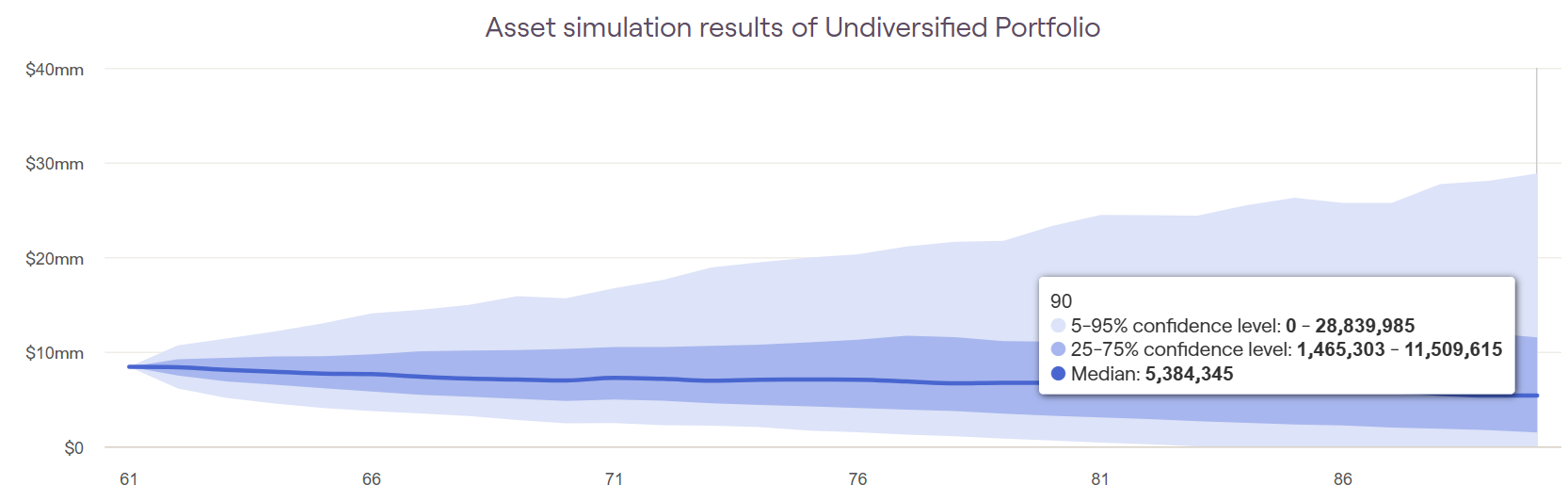
In the undiversified portfolio, ending wealth can be significantly higher. However, you can see in the simulations where things do not work out favorably, the client may find themselves out of money at age 81.
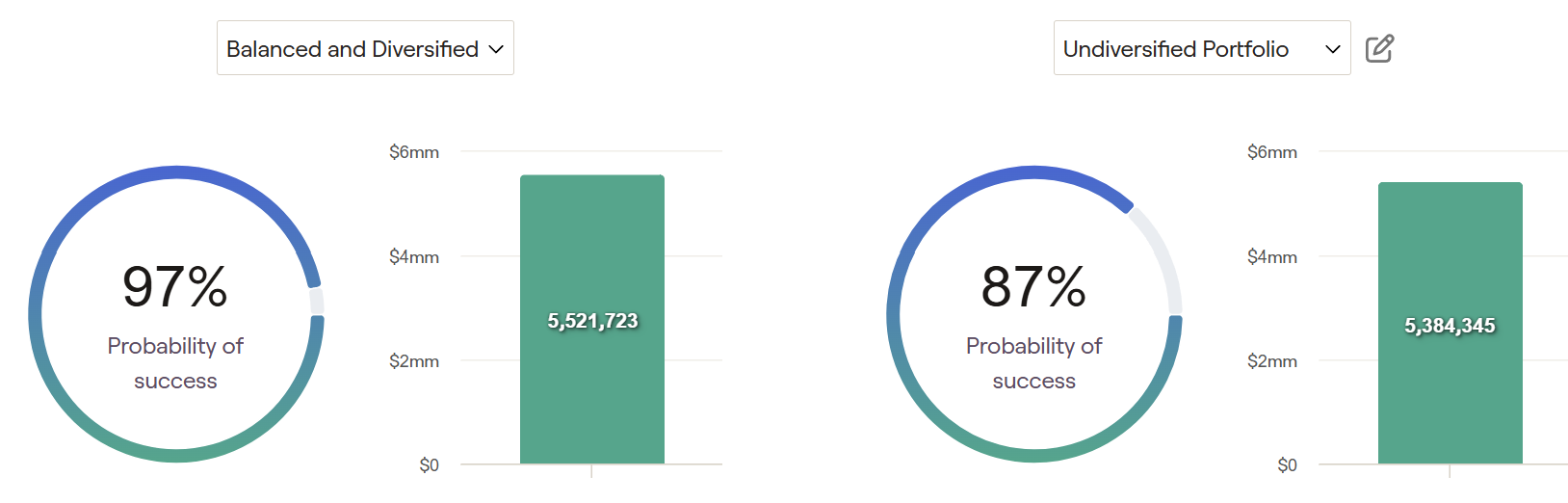
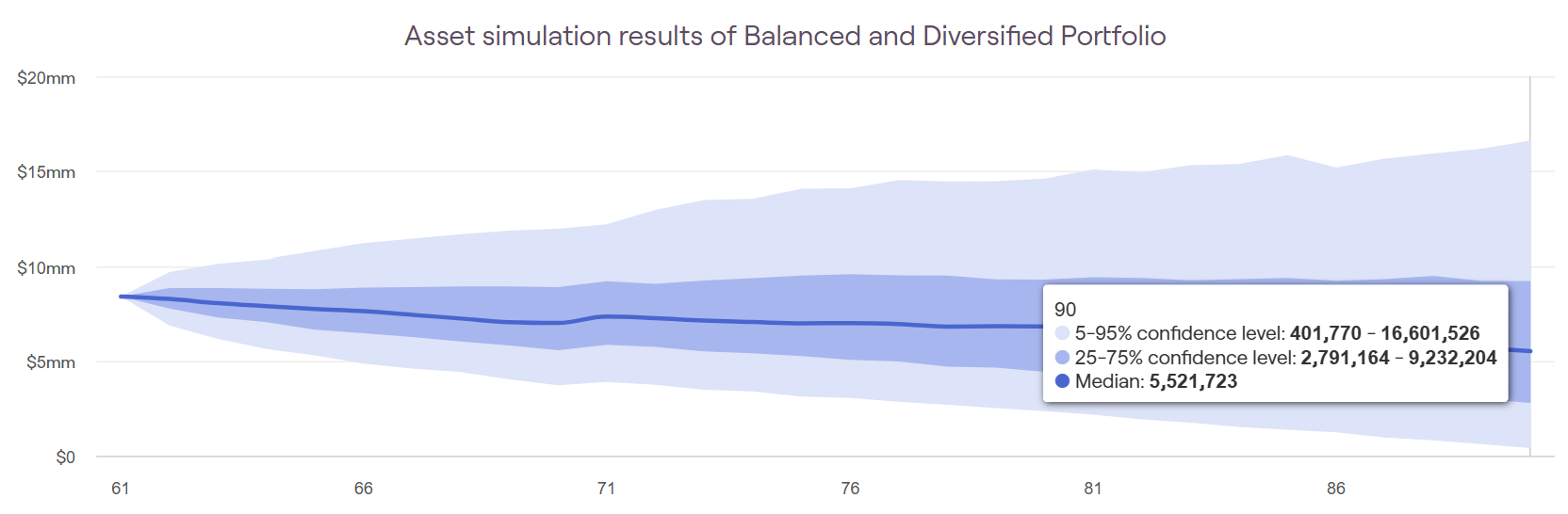
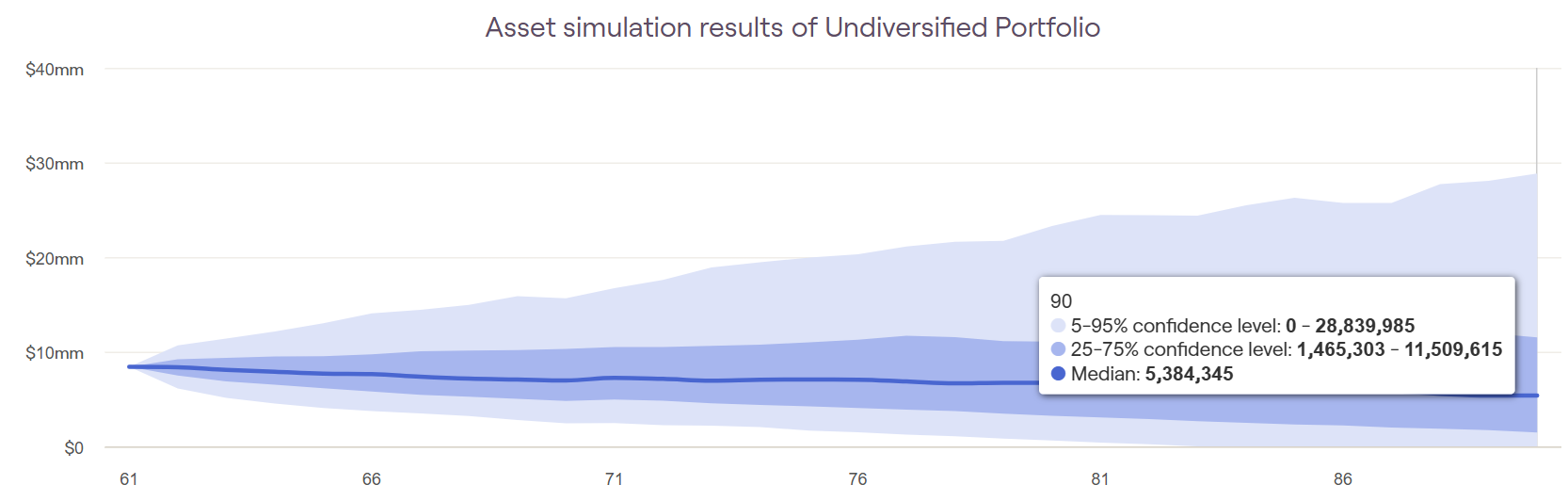
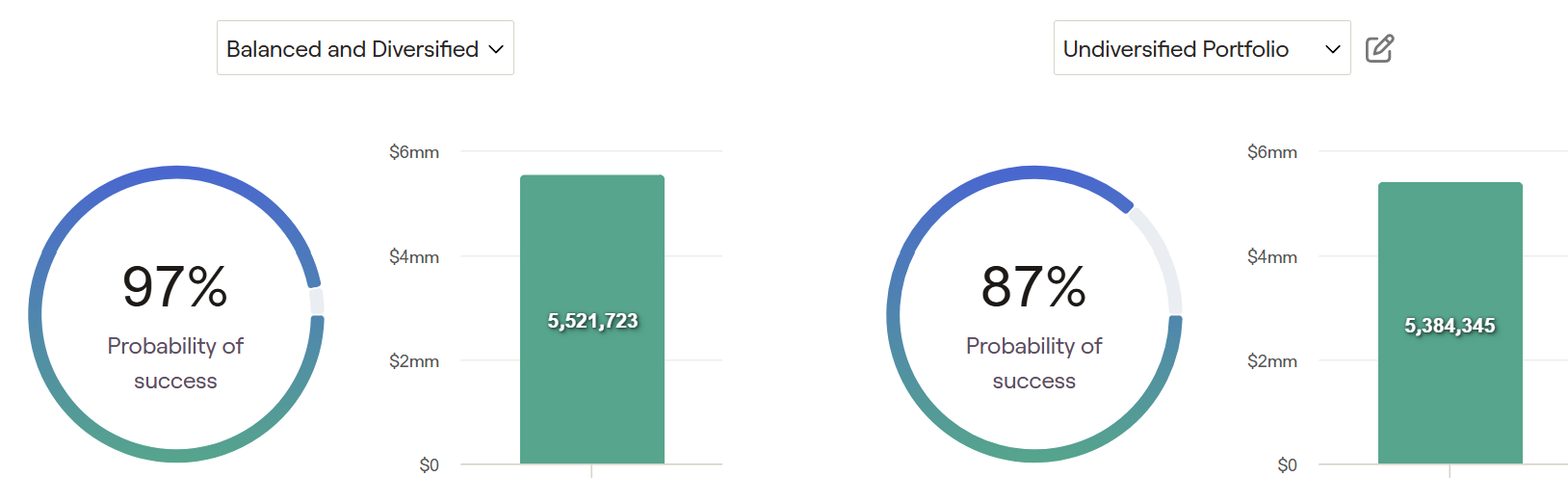
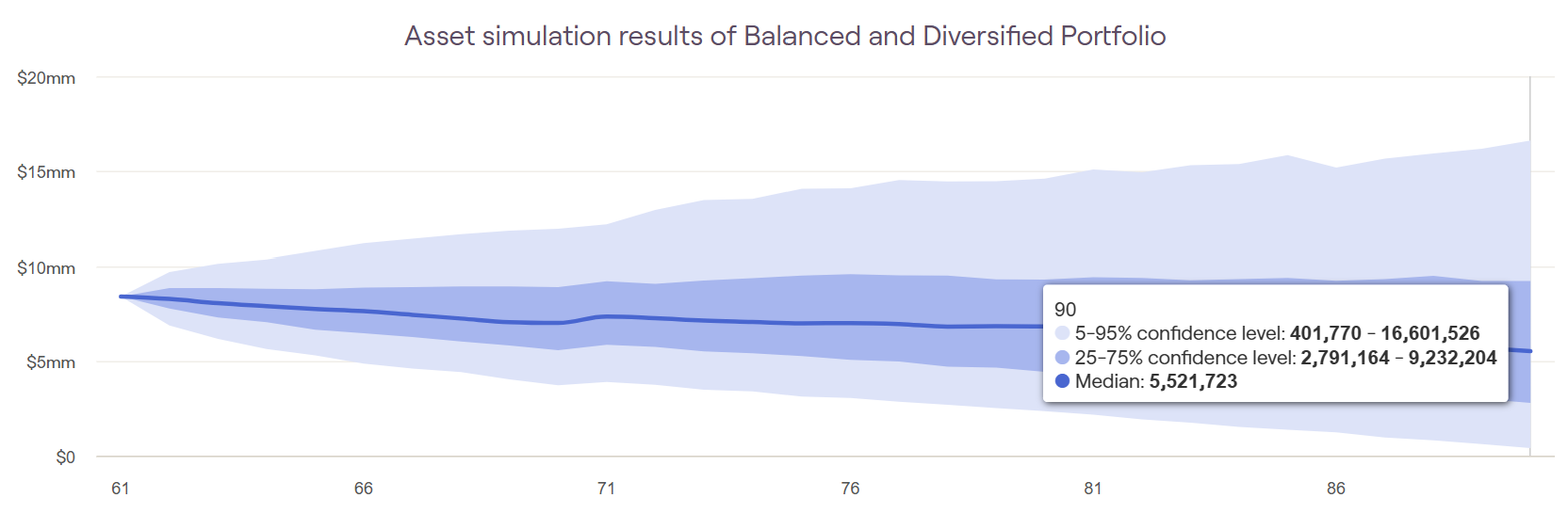
In the second set of charts👆, I ran the same comparison using a balanced and diversified investment approach, with about 60% of the portfolio in stocks. Here, the probability of success for the balanced and diversified portfolio only decreased by 1% compared to the conservative portfolio from the first set of results. More importantly, the ending wealth is higher than that of the undiversified portfolio, and the assets never fall below zero over the life of the plan.
So yes, that may mean that if things work out incredibly well, the client may not end up passing away with $29M as seen in the undiversified portfolio. But by using a diversified strategy, the client mitigated the risk of leaving their heirs nothing and sleeping under a bridge for the final nine years of their plan. That's a trade-off most of our clients would take.
Avoid the Temptation of Greed
For those looking for a dopamine rush with a slice of their portfolio, we use a goals-based approach. We look at the entire financial plan and all investable assets, establish what a client truly needs to keep a roof over their head, clothes on their back, and food in their stomach, and set that aside in a secure portfolio designed to preserve principal in times of volatility.
We then carve out another piece and match it to the future cash flows a client needs to preserve their current lifestyle. Those assets can be invested with moderate risk, because this portfolio exists to fund discretionary needs.
Once those two buckets are accounted for, any remaining funds go into an aspirational bucket. This is truly house money — the icing on the cake for goals like owning a yacht or funding philanthropy. It's different for everyone. If a client really does want to take risk and there are enough assets here to do so, that's ultimately their prerogative. Our goal is to make sure they're in a position to have that choice.
For that same client illustrated above, I drew up this portfolio using our goals-based tool. As you can see, for that client, keeping about $50K in the bank, allocating a little under $4 million to the security and maintenance bucket, and about $1.7 million to the lifestyle bucket would cover all their basic needs.
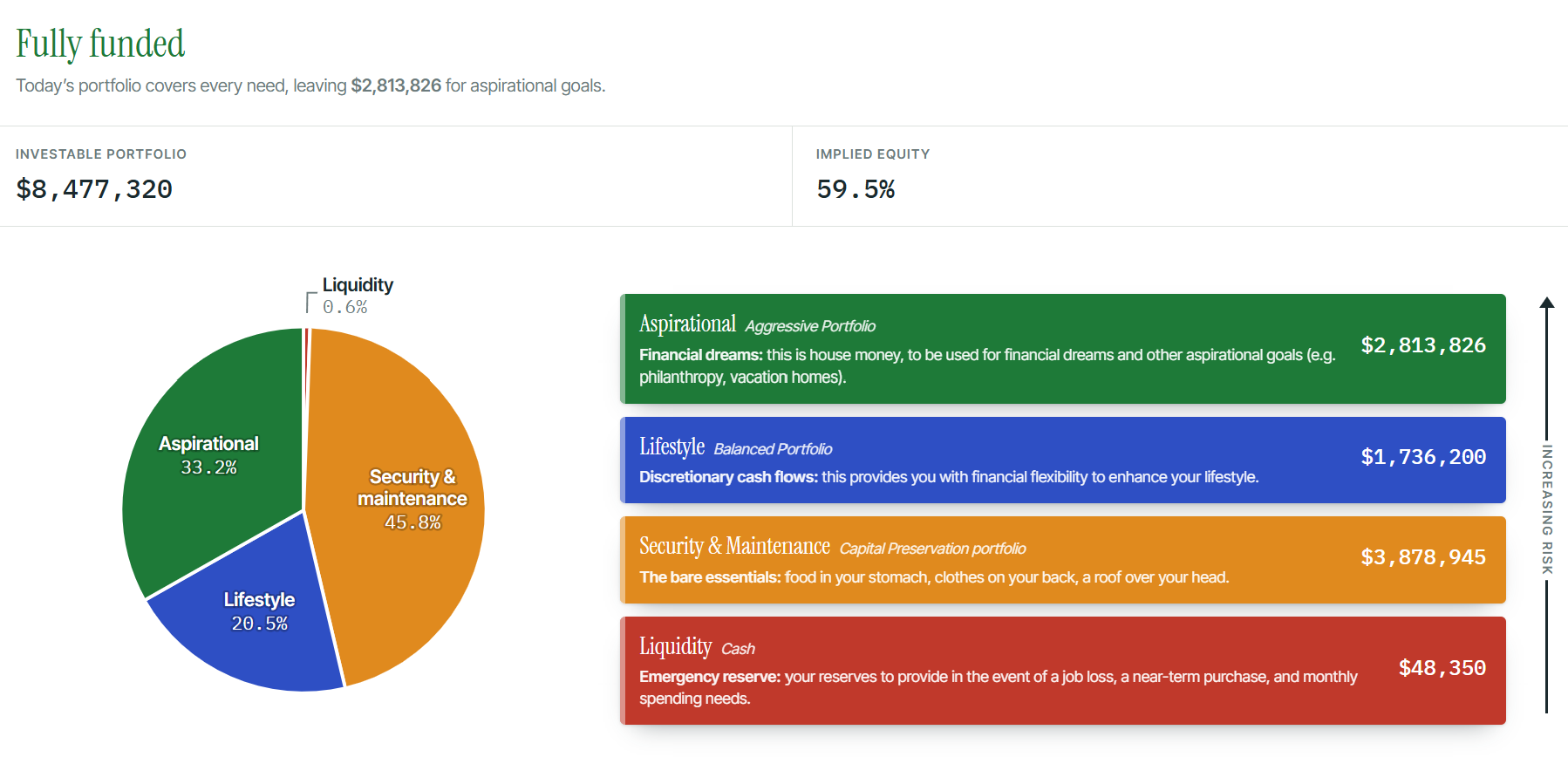
They would then have about $2.8 million of house money, or cushion, if they wanted to pursue riskier endeavors, or if the client preferred to view their investable assets in this manner so they knew the portfolio was designed with intention.
And it's not coincidental that the implied equity allocation of this goals-based portfolio is exactly what you saw in the balanced and diversified simulation with 60% stocks, which yielded the best results: downside mitigated, plan healthy, room for upside.
The Fed may hike this month, or it may not. The COLA will land where it lands in October. Either way, we'll keep building plans around the things we can actually control.
My son, meanwhile, will pick The Lorax again tonight. He already knows how it ends.
If you're curious about this proprietary tool, it's available to the public. Feel free to check it out at www.noblewealth.io/goals-based.