The hottest topic in finance these days is about something that’s supposed to be incredibly boring.
Bonds.
Bonds are the quiet, calm fellow in the corner of the room. They’re not used to us being worried about them or spending a lot of time talking about them…but there they are, the talk of the town.
Bonds are currently in the worst drawdown in modern history as an asset class. It started in 2020, post-Covid, as inflation started to look out of control and the Federal Reserve stood idly by doing nothing for another couple of years. 2022 was when we saw the worst of it, but bonds are down (again, as an asset class measured by the Aggregate Bond Index) ~17% since 2020 and we have been in this drawdown for a record 74 months.
To add some context, our last bond drawdown lasted eight months when they were down 3.8%, peak to trough. As interest rates move up, bonds go down in value.
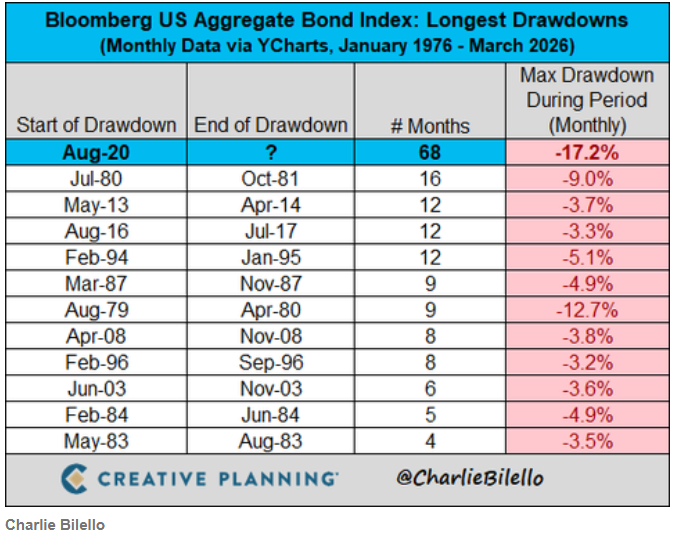
Image used courtesy of Charlie Bilello at Creative Planning
The United States was blessed with an incredible run of steadily declining interest rates from 1982 to 2020. That resulted in huge wave of asset price increases…everything from your home to your investment portfolio (both stocks and bonds) rapidly increased in value during this period of time.
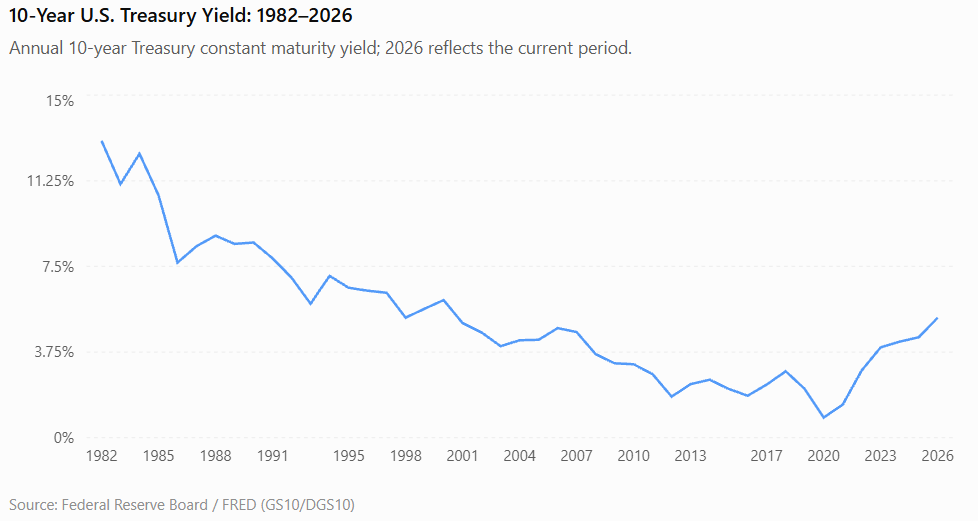
Interest rates are the straw that stirs the drink on Wall Street. Not only are they the life blood of the bond market and the banking system, but they also provide the discount rate to provide valuations on all other asset classes, including stocks. As the United States saw steadily less pressure from catastrophically high interest rates coming out of the 1970s, our economy boomed.
During Covid, as the Federal Reserve reduced their overnight lending rate to 0%, Grant and I often talked about bonds and liked to use the term “return-free risk”, as a little spin on “risk-free return” that is often used to describe the short-term US Treasury market.
The starting interest rate on a bond portfolio in 2020 was less than 2%, and closer to 1%. Despite the concern about the stock market and when the economy might come back online post sheltering-in-place, bonds looked very concerning in their own right at that level. Not because we saw a massive drawdown coming, but because there just wasn’t any juice left in the orange, so to speak.
The closest thing we have to an “iron clad” rule on Wall Street is that your expected return on your bond portfolio will be very closely related to its starting yield. If your bond portfolio starts at 1.5%, then you probably should expect a 1.5% average annual return for the next 10 years.
As you can see from that chart above, interest rates have, indeed, sharply increased in the last five years. This has created a housing market that is completely broken with mortgage rates sitting in the 7% range, the aforementioned record-breaking bond market drawdown, and increasing costs to finance anything in your life.
So, that’s the bad news. Why is this happening?
Some people will tell you that it’s because the bond market is concerned about inflation. And they’re probably right.
Some people will tell you it’s because of a rapid expansion of computing power and an insatiable demand for more of it, causing tech companies to become ravenous for capital of all kinds, thus causing borrowing costs to increase for everyone. And they’re probably right.
Others will tell you that we’re actually only starting to return to a normal interest rate environment for the first time since before the Great Financial Crisis, and that the near zero interest rate experiment we used to be in was actually the anomaly. And they’re probably right, too.
But maybe the most talked about reason that tends to lead the headlines lately is the gargantuan US government debt load and our profligate spending over the last 25 years. The United States is running a budget DEFICIT (meaning the amount of money we overspend in a given year) of ~$2 trillion, which is adding to the government DEBT outstanding, currently at around $40 trillion. People tend to get deficit and debt confused a lot.
As uber-famous portfolio manager Howard Marks recently said, and I paraphrase, I don’t remember anyone freaking out the way they are now about a $40 trillion US debt load when it was at $39 trillion. There is something about round numbers that seems to catch people’s attention. In the case of the bond market’s reaction, I think it’s probably just a small coincidence.
This is the one area that I hesitate to say I agree with any of the pundits. Don’t get me wrong, I find it to be fundamentally horrible economic policy to run large deficits when you have a growing economy. I just don’t think the US debt hitting some magic number, like $40 trillion, made bond investors simultaneously demand higher rates.
I highly recommend listening to Ed Elson on the Prof G Markets Podcast and his guest, portfolio manager Michael Green, discuss this very topic earlier this week. Green basically says that if the bond market was reacting to the US debt issue negatively, then a country like Australia wouldn’t be having the exact same issue despite having a very low debt-to-GDP number. But it is. We would expect credit spreads on US bonds to be widening. But they’re not, they’re tightening. And we would expect the dollar to decline in value. But it’s not, it’s strengthening.
In the end, rising interest rates are due to a lot of different things, but it seems to make people feel better if they can blame the government. More importantly than trying to figure out what caused this spike in interest rates is trying to understand what it means for you as an investor.
What does it mean for me?
In my opinion, there hasn’t been a better time to retire or be retired in the last 25 years than right now. Higher interest rates mean much higher income produced by the “safe side” of your portfolio allocation.
As financial planners, we talk about the 4% rule on retirement withdrawals a lot, and now you can lock in a 5.6% yield on a 30-year US Treasury Bond. You would have higher annual income than a 4% withdrawal rate would provide and never touch the principal. I’m not recommending that, because it does come with plenty of other risks, but it’s interesting, nonetheless.
More importantly, as interest rates increase, the downside pressure on a bond portfolio decreases. Example: the impact on a move from 1% to 2% on interest rates creates a much higher impact on your portfolio than on a move from 4% to 5%, or 5% to 6%.
Cullen Roche calls this concept “escape velocity”. In his example, let’s say you have a bond portfolio with intermediate duration of about 5 years. A 1% increase in interest rates would cause a portfolio with a duration of 5 to fall by about 5% - remember, rising interest rates cause bond prices to fall. If your yield on this portfolio has already started at 5%, then the effect of a 1% increase in rates is essentially nothing. The price declines 5%, but you receive 5% income from the coupon.
You will continue to see a lot more headlines using the term “bondpocolypse” and other scary stories about the impending collapse of the US government because of our national debt. I would tell you to focus on what, in my opinion, is far more practical and less attention-grabbing. Interest rates look more normal than they have in a long time. This isn’t specific to the United States and doesn’t require a moral judgement about our profligate spending (even though I would like to see it stop). The bond side of your portfolio hasn’t looked this good in over a decade. If you’re getting ready to retire, we think you’re in pretty good shape. As an investor, the bond side of your portfolio is looking pretty good.
Noble Wealth Pro Tip of the Month
I turn 50 this month, which AARP wasted no time in reminding me of with my application sitting in my mailbox this afternoon. Plus, I have an offer to receive a free trunk organizer for my car! What a deal.
50 is only a number, and as much as I want to believe it, it does come with some very important consequences. Even though I am much wiser than I was when I was 25 years old, I am also much less insurable. Life insurance is so incredibly important to the young families out there. For a young couple raising children and juggling saving money for college and retirement, it is almost universally true that you need to protect your financial plan with life insurance.
If you haven’t done it, sit down and figure out how much you need and get it in place. You may never have to use it, and that’s ok. Life insurance is the only thing I hope that you purchase and never use. We can help you figure out your best strategy for taking care of your loved ones, and doing so at a reasonable cost. We don’t sell life insurance, we help you plan for how much you need. Just set up a call.
Things We’re Reading and Enjoying
Lane Being Lane: The Story of Lane Kiffin, College Football’s Agent of Chaos - by John Talty
I rarely read for fun anymore, which is a problem I’m trying to fix. I’m a college football nutjob and despise Lane Kiffin, but I find him fascinating because we’re basically the same age. I devoured this book in a couple of nights - highly recommend to you college football fans out there.
The first book on the most polarizing coach in college sports, Louisiana State University football coach Lane Kiffin, charts his inexorable rise and his impact on the game, as he left a trail of winning teams, bad feelings, and controversy in his wake.
In his fifty-plus years, Lane Kiffin has had a rarified perch, operating among football’s biggest players, coaches, and brands. And during that time, he’s managed to annoy just about all of them.
Legendary Oakland Raiders owner Al Davis, who made Kiffin the youngest NFL head coach at age thirty-one, so hated working with Kiffin that he publicly branded him a liar.
Wall Street Veteran Michael Green: The Bond Sell-Off is a Buying Opportunity- The Prof G Markets Podcast with Ed Elson
Ed Elson is joined by Michael Green to discuss what the bond market is telling us as yields march ever higher. Then, Gil Luria returns to break down what Nvidia’s record stock buyback means for investors and what he makes of the company’s valuation. Finally, Ed gives his take on the next phase of the AI safety debate.
Michael Green is the CEO and CIO of Tier1 Alpha Asset Management. Gil Luria is the Head of Technology Research at D.A. Davidson.
“There is nothing noble about being superior to your fellow man. True nobility is being superior to your former self.” - Ernest Hemingway