I think most average people would tell you the stock market is overvalued right now. The majority of our clients tend to believe this to be true, as do most people I talk to in casual conversation. But what does that actually mean?
Sadly, I think the most often used rationale for the why the stock market is overvalued from a casual investor is that “the market has been going up quite a bit over the past few years”. While I understand the what-goes-up-must-come-down rationalization to this thought process, I think it’s important to add the proper context to this discussion.
The most commonly used statistic to measure the value of the stock market is the aggregate earnings per share, and the ratio between the stock’s price and those earnings, or the P/E ratio. Simply put, if the stock price of XYZ Company is $20 per share, and the earnings of XYZ Company are $2 per share, then that company would have a P/E ratio of 10. Is that expensive or cheap? Well, we wouldn’t know unless we compared it to other companies – but more importantly, similar companies in similar types of businesses. That’s a very simplistic start, but a good one.
Next, if we look at the S&P 500 index (the 500 largest publicly traded corporations in America) and aggregate the earnings per share for each company, and then divide that by the price of the S&P 500 Index, it will give us the valuation we can use to decide what the “stock market” is worth today. (I put stock market in quotes because people tend to use a lot of different numbers and indices to represent the whole market)
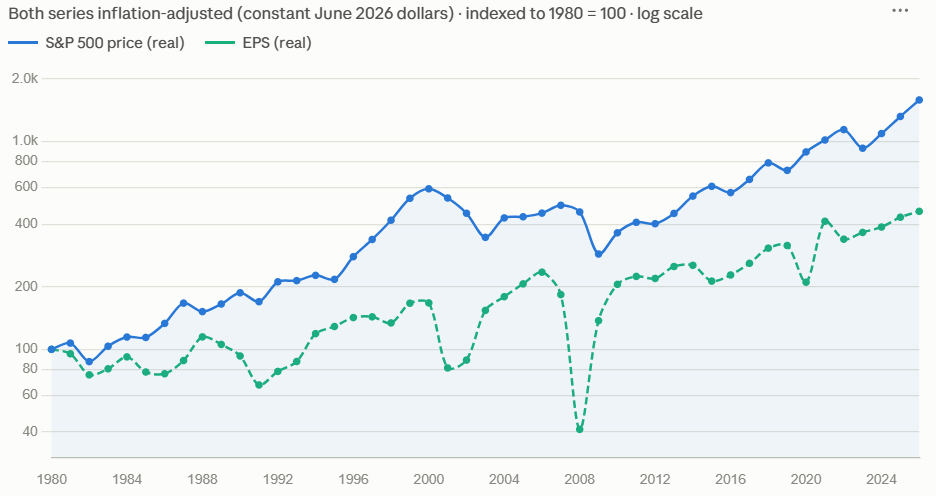
The March 2026 reported earnings per share (EPS) of the S&P 500 was $264.69, which is an all-time high. The July 2026 P/E ratio of the S&P 500 was 28.84x (essentially, what an investor will pay for $1 of earnings). Again, is that expensive or cheap? In order to put some light on that number, we can look at the historical average P/E ratio for the index, which is ~18x (going back to 1980). Given that information, we can now confidently say that the market is about 60% more expensive than its historical average. Does that make you feel better? I think you can feel pretty vindicated when you say that the stock market is looking expensive. But can you say it’s overvalued? I mean, we’d have to go all the way back to 2011-2012 to find a time period where the P/E ratio was below 18x, so maybe that’s not the best way to make a decision on it being “overvalued”.
This is a chicken and egg scenario for me. What would cause the P/E ratio to go down, thus making the market look more affordable? Well, the price of the stocks in the index could go down, which is what everyone assumes will happen when they say the market overvalued. Following the fundamentals, there are plenty of market pros who feel that this will be the way the market will correct itself. But, earnings could also go up. And that, my friends, is what we’ve been seeing in record numbers from corporate America the past few years. Earnings are continuing to climb, and the expectations that they will climb going into next year are nearly unanimous.
I’ve mentioned this a lot in my newsletters of late, but the stock market can be erratic in the short-term. In the long-term, stock prices tend to track earnings trends very closely.
Does History Rhyme?
Historically, our current timeline continues to get compared to 1997-2002. Is it a perfect comparison? Heavens no. I would never claim such a thing. But we are seeing infrastructure build out like never before, and it reminds people of the fiber optic cable/telecom boom and bust from that earlier period.
I just listened to The Prof G Markets podcast with their guest Jim Chanos, the legendary short seller. Jim, of course, sees many of those same parallels to the dot-com bust of the turn of the century.
When telecom companies went all-in to build out fiber optic cable and routers back in the late 90s, they didn’t benefit from their efforts with higher stock prices…most of them went bankrupt. But they did leave behind some incredible assets and infrastructure for the next wave of companies to benefit from just five years later.
Is that how we need to view this build-out of data centers and high-powered computer chips? I’m not sure, neither are you, and nobody else is, either. It’s easy for people to get nervous about AI, to see Google’s free cash flow going negative for the first time in its history while the industry spends trillions of dollars (literally) in a race to build “super intelligence”, or Larry Ellison betting the future of his entire company, Oracle, on this next wave of technology and say, “for what? To have a chat bot on my computer that hallucinates and lies to me? Or to have a bunch of digital slop passing as creativity in my social media feed?”
What Might the Future Look Like?
In times like these, it’s much better to try and understand things that you might not have the most expertise in than to just assume you have all the answers.
It costs me $200 a month to own a Claude Pro license. Some say that same license costs Anthropic about $1,000 per month to service. If we’re going to try and understand why all of these hugely profitable tech companies are willingly spending trillions of dollars just to lose a ton of money…well, then…we’re going to be rightfully confused.
There is a lot more to AI than hallucinating chat bots and high school students cheating on their term papers. I won’t get into all of the details, but I highly encourage you to read this piece from Josh Brown of Ritholz Wealth.
“…amid all the uncertainty on Wall Street about all of the money being spent to scale the data centers, he’s (Alex Kantrowitz) fairly certain that this compute will not go unused. More importantly, there is a belief out there that we are nowhere near built-out to answer the cascading amount of demand coming when the agentic future takes hold. If we’re going to have a billion people ordering around their own AI agents to carry out tasks and handle transactions, the current state of compute simply cannot support it. Which means compute prices are going higher and the infrastructure build will have to continue - or, quite possibly, even accelerate.” ~Josh Brown
Right now, we aren’t seeing everything that AI could eventually become, and therefore we may be underestimating what is coming down the pipeline.
Are There Signals?
Unfortunately, I have to conclude this month’s newsletter with a disappointing ending. There simply aren’t any signals out there to properly predict the ups and downs of the stock market with any real efficacy. I know you may think that you can choose to look at current valuations and decide that you may want to sit on the sidelines for a while. I’m afraid that would probably be a mistake. Not because I’m positive that the stock market will keep going up, but because I just don’t think there is enough information available to ever make that decision. I know the market will have corrections, bear markets, and crashes. That will happen again…but there isn’t any information available to us to predict when it will happen.
If you make the decision tomorrow that you are going to sell your investments and sit in cash and the market goes up another 50%, how will you feel? Would you feel the same if you stayed invested and the market went down 50%? Missing out on positive returns is mathematically equivalent to losing money on your investments. It’s just how your brain decides to look at it.
Warren Buffet, largely considered to be the greatest investor of all time, doesn’t sit on the sidelines. His favorite holding period for his stocks is “forever”.
What about Jim Chanos? You know, the guy that spends every hour of every day looking for reasons that companies are going to trade to $0? His investment strategy is to be “long the market” with some highly selective shorts that they are confident in. He stays invested even when things look their bleakest.
Chanos tells a story of how The Economist predicted exactly how the dotcom bust was going to happen. Where the cracks would form first, what companies were going to suffer the worst losses, what was going to happen to the broader economy and the stock market. It was an amazing prediction. Except it happened in 1997 and the Nasdaq tripled again before their prediction came true.
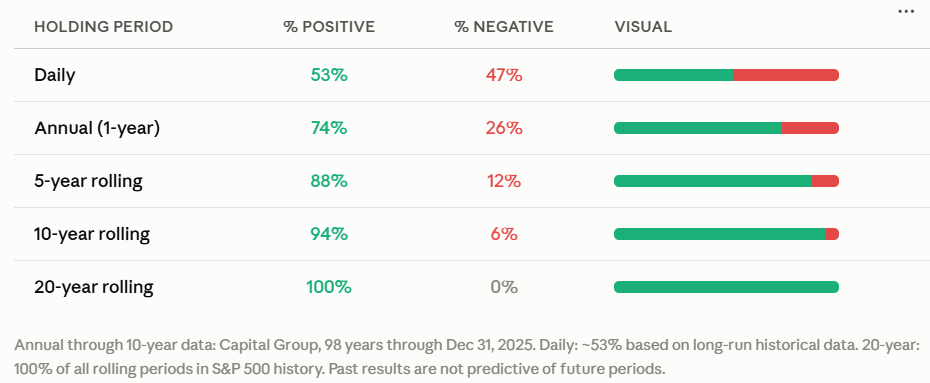
The numbers don’t lie…and I will continue to pound this statistic into the ground. The stock market, on average, is up in three out of every four years. Over a 10-year time frame? 94% of the time, and 20-years? You would have positive returns 100% of the time.
People who understand statistics know that the best way to lose in the stock market is to simply choose not to participate.
Noble Wealth Pro Tip of the Month
Half way through the year is an amazing time to pull your paystub and start doing some tax planning. I mean, it’s too hot outside to do anything else, right?
Seriously, though. One of the most common personal finance issues that we see at Noble Wealth is people having very little understanding of their tax situation. Are you withholding enough from your paychecks? Did you have an unexpectedly large gain from the sale of real estate or your investment portfolio? Did you make an estimated payment with the IRS in the quarter when that gain took place?
So many questions, and so little time remaining. If you are tired of getting stuck with a huge tax bill every April, you’re probably not withholding enough for taxes. You have five months to adjust that with your payroll provider right now to try and shore things up.
We are actively reaching out to our clients to try get a jump on this. The first half of the year is long enough to spot trends while giving you enough time to course correct before December 31st.
Things We’re Reading and Enjoying
We ain't seen nothing yet. - Downtown Josh Brown
Most people who are reading all the articles and absorbing all the Wall Street commentary about capex bubbles are thinking in terms of the technology we have today. Coding assistants and chatbots and user-generated artwork. These are the use cases they see in front of them. They’re obvious and familiar and tangible. But they’re not thinking about what it’s going to take to facilitate the existence of a hundred million autonomous cars and trucks, humanoid robots, automated manufacturing operations and other such things that are a little further out on the horizon. However, the people making these investments with trillions of dollars and multi-decade time horizons are thinking precisely this way. More. The bottom line is we will definitely need more.
Jim Chanos: We are in the Golden Age of Fraud - The Prof G Markets Podcast with Ed Elson
Ed Elson and Scott Galloway are joined by Jim Chanos to discuss the biggest risks he sees in today's AI-driven market and the warning signs that remind him of the late stages of the dot-com bubble. He also breaks down the companies he's long and short on, explains why he's increasingly concerned about fraud in the market, and shares the advice he'd give to young investors navigating today's environment.
“There is nothing noble about being superior to your fellow man. True nobility is being superior to your former self.” - Ernest Hemingway