Money anxiety is a real thing, and a lot of people suffer from it. And when I say a lot of people, it’s not just people on the lower end of the income spectrum. I’m saying that just about everybody suffers from it, and I spend the majority of my days talking with these folks about it. Retired people worry if they’ll have enough money, younger people worry if they are saving enough money, rich people worry if they’re doing the right things with their money, and less fortunate people worry about it all.
A piece written by Michael Green, a portfolio manager for Simplify Asset Management, came out last week and took the economics/personal financial world by storm. In our nerdy little corner of the world, it was all anybody could talk about. I would highly suggest you take a minute and check it out on Substack, or read the shorter version here circulated by The Free Press.
The essential theme to this piece and why it’s hitting so many nerves is the discussion of the Federal Poverty Line, which was first established in 1963. At the time of its creation, it was noted, that the average American family spent about 1/3 of their household budget on food. So, to create a trustworthy index of what it meant to be poor, Mollie Orshansky at the Social Security Administration, came up with multiplying that number by three. Henceforth, the measure of poverty in the United States was 3x the cost of food. That was it. It was simple, it was reliable and created a floor of income inadequacy. If you had to spend all of your income on food, you were in trouble.
Obviously, over the last 60+ years, many things have changed. The general summary that Green puts forth is that you can’t simply rely on the cost of food anymore to gauge the poverty line in America.
To summarize, Green goes into a deep dive of what it actually costs to live in America and attempts to draw a more suitable “poverty line” for 2025 than what was created back in the Kennedy administration. Making a long story very, very short, Green comes up with the number $140,000 per year for a family of four as his new definition of today’s actual “poverty line”. I’m using quotes for reasons that will become obvious here in a minute.
The critiques of this article came fast and furious. To name just a few…
The $140,000 Poverty Line is very silly - by Noah Smith
How Not to Redefine Poverty - by Scott Winship
The Myth of the $140,000 Poverty Line - by Tyler Cowen
These are all excellent pieces in their own right. But there is also a boatload of people jumping in to give Green the credit he deserves for articulating a point that is not being made very well by politicians at the moment – Americans are angry and things are expensive.
Green has been very transparent in saying he wanted to at least start a discussion about this and tried to define things that needed to be quantified for a more reasonable definition of poverty. The cost of food? Sure, but also health insurance, rent/housing, childcare, and transportation.
Here are the numbers he chose using simple national averages on an annual basis:
Childcare: $32,773
Housing: $23,267
Food: $14,717
Transportation: $14,828
Healthcare: $10,567
Other essentials: $21,857
There are many obvious problems that should jump out at you immediately, and the first is that the “national average” is just not a great benchmark when you’re comparing people living in Manhattan, New York to those living in Manhattan, Kansas.
Talking about spending money is very personal, too. Some people will say that their families need two cars, while others think having any form of transportation like that is a luxury and unnecessary because they utilize public transit. Some think it’s a luxury to buy name brand cereal or too much fresh produce, others find those things to be a necessity. Some are going to think that the childcare costs number is way too low, some too high because they have family that can assist them. So, you’re always going to get gigantic arguments about any of this stuff if you try to make it an “average American” thing. You get the picture.
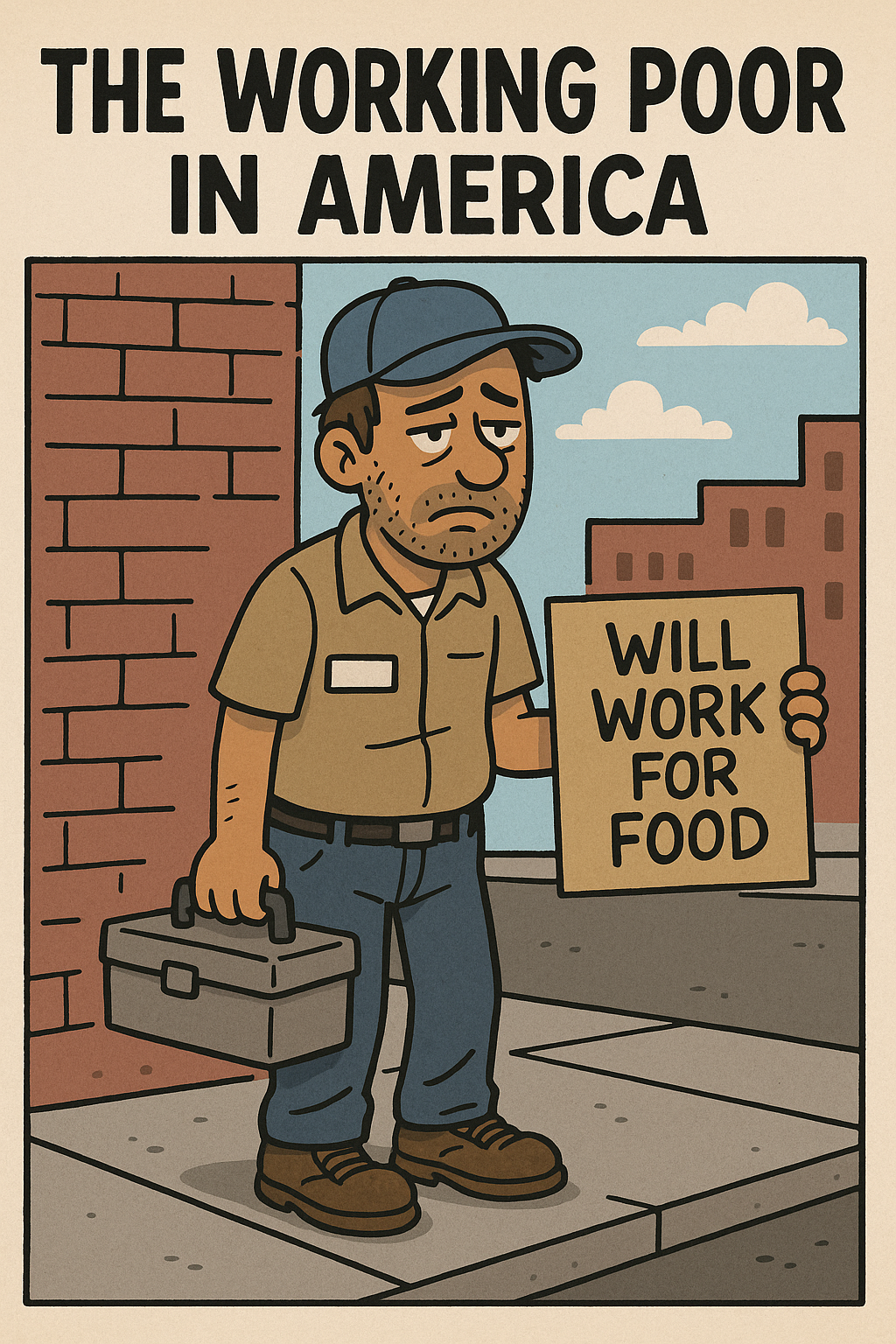
Where economists get very angry with this piece is a little different, and that’s because they believe this makes actual poverty look trivial, and it shouldn’t be. Being poor isn’t about whether or not you can afford a car to go to work, it’s about not knowing where your next meal will be coming from. I understand those concerns, as well.
However…
I think Green does an excellent job of showing things in our lives that people feel a need to have just to feel like they are participating in this economy. And one of the biggest points that he makes, which generally goes unnoticed, is that the decision to go from today’s actual poverty line for a family of four – which is equal to $32,150 per year – to making more money puts that American family in a decision bind. Because, if you make too much money, you won’t get the tax credits on your health insurance, you won’t qualify for food stamps, you’ll have to pay for health insurance vs. being on Medicaid, etc.
“The anger isn’t about the goods. It’s about the breach of contract. The American Deal was that Effort ~ Security. Effort brought your Hope strike closer. But because the real poverty line is $140,000, effort no longer yields security or progress; it brings risk, exhaustion, and debt.
When you are drowning, and you see the lifeguard throw a life vest to the person treading water next to you—a person who isn’t swimming as hard as you are—you don’t feel happiness for them. You feel a homicidal rage at the lifeguard.
We have created a system where the only way to survive is to be destitute enough to qualify for aid, or rich enough to ignore the cost. Everyone in the middle is being cannibalized. The rich know this… and they are increasingly opting out of the shared spaces.” - Michael Green
MY THOUGHTS
I thought the piece was excellent, even though flawed, and I also thought the semantics around Poverty and Participation were lost on a lot of people critiquing this piece, but should definitely be noted. $140,000 a year for a family of four is most definitely not poverty. But I think it is a reasonable number for a line of participation for that family of four.
When I graduated from college oh so many years ago (1999), my starting salary was $27,000 a year. I netted out ~$1,700 a month and after my rent, car insurance, and utilities, I had about $600 left over for everything else, including food. I didn’t feel poor, but I was definitely stretched. My girlfriend (now wife) was still in college, but we somehow made things work. We knew that things would eventually start getting easier if we both worked hard. After all, that was what we were told. That was the social contract in America.
There has been a lot of talk about this social contract lately that was implied to young Americans since the end of WWII, and it went something like this. Go to college and get an education, even if you need to borrow money to do it. You know why? It’s worth it, and it will open up a lot of doors for you and allow you to live a more comfortable life.
That is exactly what was pounded into my Gen X brain from the time I was in elementary school. Going to college was not an option for me, it was expected. My parents hoped it would provide me a better standard of living than they had. I’m 49 years old and that social contract has proven to be pretty valid for me and my family.
Except…
Participation is becoming more and more difficult when housing is utterly unaffordable for young Americans. If you’re fortunate enough to own a home, it’s now very difficult to move to another location for a new career opportunity. You want to have kids? Good luck, because day care is a like having a second mortgage. Speaking of second mortgages…you want to talk about health insurance? By the way, how much have you saved for retirement? You think your kids are going to pay for college themselves? I think you get the picture.
I’m certainly not arguing for the government to intervene here, and I’m not sure I want to hear any recommendations for how they could potentially fix this situation. Health insurance is broken and neither party can come up with a solution to fix it. Housing, however, is a solution that I think could start to fix a lot of what ails us as a nation. I’ve mentioned this a lot in the past, but I’m a huge fan of the Abundance movement made popular by Ezra Klein and Derrek Thompson. If you want the cost of something to come down, you can do one of two things: hope people stop wanting it or make more of it.
It’s far past the time to focus on what’s important for this country, and we need to have plans to fix issues with affordability. We need to build more homes, and we need to do it now. That will go a long way in helping the next generation of Americans feel like they have a chance to participate in the economy in a meaningful way.
Noble Wealth Pro Tip of the Month
The end of the year is upon us and we’re all going to be busy decorating our homes, enjoying holiday parties, and eating and drinking a little too much. That’s OK. But we also have to be aware of the end of the year for some very important deadlines, mostly in the name of tax planning.
If you’re looking to reduce your income number before December 31st, you can pretty much focus on a few items that need to be done quickly.
Fully fund your 401k with pre-tax deductions ($23,500 per person, with an additional $7,500 if you’re over 50)
Max out your Health Savings Account ($4,300 individual, $8,550 for a family and you have to be on a qualifying High Deductible Health Plan first)
Tax-loss harvest in your taxable brokerage account (sell stocks at a loss if possible)
Make charitable donations
Next year, the amount of charitable donations that high income earners can deduct from their income goes down quite a bit from the current law, so bunching up your donations this year and utilizing a Donor Advised Fund could make a lot of sense. Make sure you talk to your tax professional first.
Things We’re Reading and Enjoying
Part 1: My Life Is a Lie - How a Broken Benchmark Quietly Broke America, by Michael Green
Markets, liquidity, factor models—none of these ever felt self-evident to me. Markets are mechanisms of price clearing. Mechanisms have parameters. Parameters distort outcomes. This is the lens through which I learned to see everything: find the parameter, find the distortion, find the opportunity.
But there was one number I had somehow never interrogated. One number that I simply accepted, the way a child accepts gravity.
The poverty line.
The "$140,000 poverty line" is very silly - by Noah Smith
People love to say that the American middle class is poor. But it's not.
Despite its popularity, Green’s claim is wrong. Not just slightly wrong or technically wrong, but just totally off-base and out of touch with reality. In fact, it’s so wrong that I’m willing to call it “very silly”. I know Mike Green, and I count him as a friend, but we all write silly things once in a while,1 and when we do, we deserve to be called out on it.
Why is the $140,000 poverty line silly? Well, there are two main reasons. First, Mike actually just gets a lot of his numbers wrong when he makes his calculations. And second, the way Mike is defining “poverty” doesn’t make any sense.
“There is nothing noble about being superior to your fellow man. True nobility is being superior to your former self.” - Ernest Hemingway