Happy April Fool’s Day! But no jokes here for the newsletter, I’m sorry to say, I’m just going to flatteringly imitate the great Cullen Roche with three things I’m thinking about heading into spring…
Corruption
I’m really tired of corruption. I mean, really tired of it. And I’m really tired of a specific kind of corruption. It involves the markets, likely because I’m so close to them, and the use of privileged information to trade and speculate and make millions of dollars.
I hesitate to call it insider trading — I've been told it technically isn't — but if it looks like a duck and walks like a duck…
I’m specifically talking about a bunch of very large and recent options trades that have raised a lot of eyebrows as they went off following comments from President Trump regarding the war in Iran.
On Saturday, March 21st, President Trump issued some pretty serious threats to Iranian leaders to open the Strait of Hormuz within 48 hours or face military action. Then, shortly before U.S. traders returned to work on Monday, March 23rd, Trump backed off, posting on Truth Social that the U.S. and Iran had been in "very good and productive conversations" about ending hostilities in the Middle East. Markets predictably rallied on the news.
Per the reporting of the Financial Times, roughly 6,200 Brent and West Texas Intermediate (types of oil) futures contracts changed hands between 6:49 a.m. and 6:50 a.m. ET — just 15 minutes ahead of Trump's Truth Social post — with a notional value of $580 million. A similar increase in S&P 500 e-Mini futures was observed, representing more than $2 billion in notional value. As the markets rallied and the price of oil went down, whoever was responsible for these outsized trades made a fortune.
Now, two things can be true at the same time. The White House may not have actually known that this was happening AND, simultaneously, someone close to the White House may have used privileged information to make these trades. By all accounts, the activity was highly unusual and struggled to pass the smell test.
Margaret Ryan, the SEC's top enforcement official, resigned last week after clashing with SEC Chair Paul Atkins over her attempts to pursue cases connected to White House officials.
But this is just the most recent example. A year ago, there was similar activity after the announcement of very large tariffs on Liberation Day and the subsequent 90-day delay that followed. Secretary of Commerce, Howard Lutnick’s son Brandon, who took over as the head of Cantor Fitzgerald after his father’s appointment to the cabinet, cornered the market on trading tariff-related rights that American companies held under IEEPA — essentially profiting from policy his father was helping to set. Not to mention countless members of congress, most notably Nancy Pelosi, and their incredible track record of trading stocks around insider information. Pelosi’s “performance” for her personal portfolio became such an open joke amongst Wall Street professionals, that the firm Tidal Financial Group started an ETF (ticker: NANC) tracking her trades and the trades of other Democrats in Congress, as well as the GOP equivalent (ticker: CRUZ).
Despite what you may think, I’m not making this political. I am saying that the rest of us are held to a much higher standard than this and it is far past the time to completely ban the trading of stocks by elected members of the United States government. Martha Stewart went to prison for lying about and covering up a trade that her broker made for her with inside information to save ~$45,000…we simply deserve better from our elected officials, which should be easy to agree on.
There’s trouble brewing for college graduates
One of the more troubling issues that seems to be bubbling to the surface with the emergence of AI has been employment opportunities for young people. I have two kids in college and one about to enter, so this one hits close to home.
The easy narrative at play here is that AI is taking away entry level jobs, thus young people graduating from college are not getting the opportunities they used to get. This goes for administrative jobs on the lower end of the office pay scale, but also for young lawyers, software engineers, and junior investment banking associates.
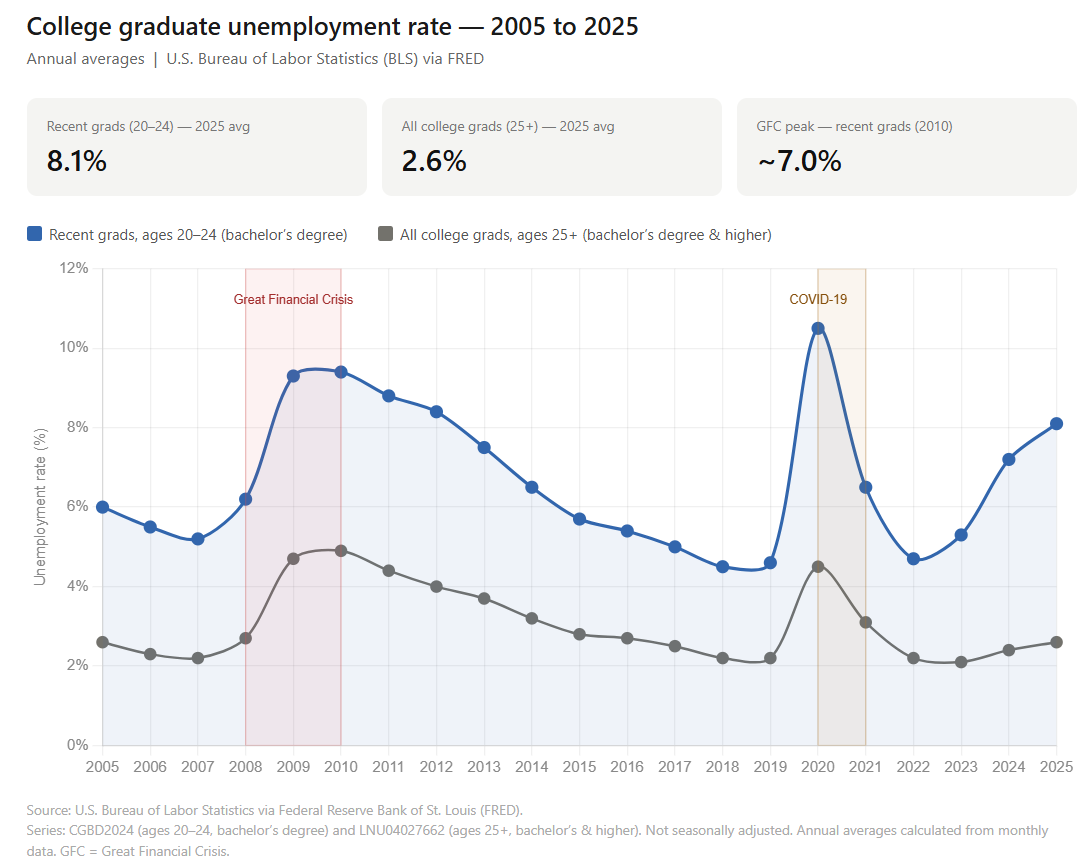
The data tracked by the St. Louis Fed seems to support this narrative. The unemployment rate amongst this cohort of recent college graduates spiked at the end of 2025 to almost 6%, but the underemployment rate – meaning college graduates taking jobs that don’t require a degree – is up to 42.5%. This is not a good trend. While still below the Great Financial Crisis levels that peaked at 7% unemployment for college graduates, it’s the underemployment rate that is off the charts right now.
There is no question that the Artificial Intelligence industry has a major messaging problem. Noah Smith recently wrote a piece on AI’s horrendously bad sales pitch.
“AI has the worst sales pitch I've ever seen. ‘Our product will make you economically useless, and possibly kill you’ is not a value proposition. ~Noah Smith
Worst of all, it’s the people who actually run these companies that are putting this narrative out to the world, people like Dario Amodei of Anthropic and Sam Altman of OpenAI.
I don’t know what comes next with AI. Predicting the future is impossible and nobody has a crystal ball. But, I find it hard to believe that the world can function in an economy where 90% of the population doesn’t have a job. If nobody has any money, who will pay for things? Seems implausible. But I’d be lying to you if I said it doesn’t worry me.
Bill Gurley, legendary venture capitalist and longtime partner at Benchmark Capital, was on the Prof G Markets Podcast recently and started to give me some hope. While I suggest listening, I’ll paraphrase where he sees the future of AI and employment going.
Essentially, his recommendation is for young people (and old people, for that matter) to find something that they’re really good at and curious about. The momentum you have when you’re curious and eager to learn is impossible to beat, and that is where you find nuance in your field, and nuance is where you gain competitive advantage. This, along with embracing AI to make you better at your job, is the key to a productive future. By contrast, going to school to pursue a career that “pays the most” or your “parents expect you to go into” is probably a road to unemployment, as is refusing to learn and embrace AI tools.
The “where should I invest now?” question
Finally, the most popular question that I’m hearing daily right now from friends, family, colleagues, and clients. I would be remiss if I didn’t talk about what everyone has on the tip of their tounges.
How should I invest right now, or should I even be investing my money at all right now?
A number of people that I respect on Wall Street are saying some things that I think most people want to hear in times like these. Something to the effect of “there is a lot of uncertainty and we don’t know where the bottom is, so you should be careful.”
My problem with this line of thinking is that we never know where the bottom is, nor can we. Everything that happens to you every single day is uncertain.
When it comes to trading stocks and bonds, if you’re looking to make some trades in the short-term, less than a year out, then you’ve basically got a coin flip. That’s speculation, not investing. Investing money in productive assets is and always will be a long-term game that requires patience and a steady hand.
Warren Buffett was asked this question on CNBC recently and said the only thing we know for certain during a war is that “the value of money goes down”, which means that inflation goes up. Hoarding your cash in a savings account is a sure path to losing purchasing power. The solution, of course, is to buy productive assets. Stocks, bonds, and real estate…things that produce cash flows.
Buffett is 95 years old, but still has his fastball, “I’d be buying stocks even if I knew World War III was starting tomorrow.” Trying to predict when things will be 'less uncertain' is impossible — and so is timing your entry point on new cash.
“Although the world almost inevitably feels more uncertain, it is important to remember that financial markets are always inherently uncertain. That is why political, economic and asset-class forecasts are so consistently wrong. We have not suddenly moved from a predictable environment to an unpredictable one. Over the past century we have lived through enormous social, political and economic shifts, and major asset class returns have held up well through these. That long-term resilience, however, does not mean that such environments are easy for investors. They are not. They create profound challenges – many of them behavioral.” ~Joe Wiggins, Behavioural Investment
There are some major behavioral biases to look out for when things like this happen. Novice investors often inflict pain on themselves in times like this waiting for the 'dust to settle,' missing large upswings in the market, or allowing themselves to be sold products that promise some illusion of safety.
“The bad news is that all of this is troubling in the short-term. The good news is these big geopolitical events tend to be relatively unimpactful in the long-term. So, if you’ve got a long-term perspective and you’ve matched your assets and liabilities correctly, this shouldn’t really be altering your plan at all. That said, stocks are down 8.4% and bonds are down 2.5%. Those aren’t huge numbers, but they could be altering the way you’re thinking about investing new cash.” ~Cullen Roche, Discipline Funds
As unsatisfying as all of this is, the obvious answer is to keep investing and stick to your plan. Diversification is your friend. If you can’t handle some short-term volatility, then you need to look in the mirror and try to understand why. When stock and bond prices go down in the short-term, they make the longer-term benefit of owning them much more attractive. This is something you need to be telling yourself every day.

Noble Wealth Pro Tip of the Month
Tax Day is a mere two weeks away. How are you handling that this month? Have you gathered your documents? Have you contacted your CPA? Did you remember to fund your IRA or Roth IRA? All of those things have a way of sneaking up on people.
My recommendation, if you haven’t started yet, is to sit down this weekend and create a folder on your computer, or a physical folder, for everything you think you need to prep your return. Then, sit down at your desk and just get started. Questions will arise and things you may have forgotten about will come to light. There is no substitution for action.
As I tell my clients all the time, your tax return is an historical record of things that have already happened. There isn’t much you can do now (legally) to change those things, outside of a few accounts (like the traditional IRA, a Health Savings Account, or a SIMPLE/SEP for the self employed) that can lower your tax liability.
Things We’re Reading and Enjoying
The AI Divide: Who Wins and Who Gets Replaced - ft. Bill Gurley - Prof G Markets Podcast
Ed Elson and Scott Galloway are joined by Bill Gurley to break down how young people can position themselves for success in the age of AI, how Silicon Valley and the private markets have evolved, and what a potential market correction could look like.
Bill Gurley has been General Partner at Benchmark Capital since 1999. His new book, “Runnin’ Down a Dream: How to Thrive in a Career You Actually Love,” is available now.
The $1.5B Insider Trade Before Trump’s Iran Post - ft. Anthony Scaramucci - Prof G Markets Podcast
Ed Elson speaks with Anthony Scaramucci about the surge in insider trades tied to Trump’s Truth Social posts on the Iran war. They discuss how widespread the corruption may be and whether it could carry political consequences. Then, Steve Eisman returns to the show to break down the deepening cracks in the private credit market. Finally, Ed examines the pattern of insider trading allegations throughout Trump’s second term, and what, if anything, can be done to rein it in.
Has the World Really Become More Uncertain for Investors? - by Joe Wiggins, Behavourial Investment
One thing I am certain of is that, in recent years, investors have talked a lot about “rising uncertainty”. While it undoubtedly feels that way, it is not always clear what we actually mean when we say this – isn’t the world always uncertain? Because it is not obvious what this uncertainty consists of, it can be difficult to know what to do about it.
Any conversation about uncertainty needs to begin with the idea of risk. The two terms are often treated as synonymous, but they are different – and that difference matters.
“There is nothing noble about being superior to your fellow man. True nobility is being superior to your former self.” - Ernest Hemingway