Mental Poison
We just wrapped up a spooky week in the stock market. The Nasdaq Composite posted its steepest monthly drop since March of last year as concerns mounted over hyperscalers' surging artificial intelligence spending.
I was planning to write about something uplifting this month, maybe how building wealth can give you the flexibility to free up your time and pursue fulfillment and purpose. But that will have to wait, as political uncertainty and stock market volatility are clearly weighing on investors' minds.
I'll briefly review the investment backdrop and the key themes I'm watching, then explore how political views can act as mental poison to derail your financial goals and how stocks have historically performed during and after midterm elections.
In a Nutshell:
Last week, the market spotlighted the million—or should I say trillion—dollar question: will hyperscalers' massive AI investments eventually pay off, or is AI spending a money pit? It wasn't pretty. Memory stocks, which are up hundreds of percent this year, sold off alongside Amazon and Google as investors were unimpressed by their latest quarterly results. Investors are either all in or all out on the AI trade. Investors were all out at the start of last week until the Anthropic IPO rekindled AI enthusiasm (all in), only for tech to sell off again late in the week (all out). Adding fuel to the fire (literally) were renewed Houthi attacks on Saudi oil infrastructure and rhetoric suggesting the U.S. would begin aggressive strikes on Iran once the midterms have passed, pushing oil prices higher. Normally, that kind of inflationary pressure would lift interest rates, but clear risk-off sentiment sent rates lower and bonds fared well. Unfortunately, gold didn't hold up, slipping below $3,900 an ounce, about 30% below the roughly $5,500 peak it hit before Operation Epic Fury and the war on Iran.
Key Themes:
Fed: On hold until December. Inflationary pressures will likely prompt another hike, but not an aggressive hiking campaign.
Rates: Tolerable, but worth watching. Long-term rates drifted above 5% last month. As I've written before, that level doesn't automatically end a bull market, but it can start to squeeze consumers. Think of interest rates as a car's brakes: the economy can keep moving with pressure on the pedal, but the longer that pressure lasts, the greater the risk of a stop.
Earnings: The strongest support for this bull market. Q3 earnings growth is around 30% (FactSet), while European earnings growth is projected to be in the mid-20s. Valuation multiples (the price investors pay for each dollar of earnings) have declined, but earnings have grown fast enough to drive substantial market gains over the past year. That's a positive fundamental backdrop.
Breadth: Strong headline earnings don't tell the whole story. AI drives most of the index's profits and market capitalization, while the median stock's earnings are up only around 9%. Historically, that gap closes in one of two ways: the leaders fall or the laggards catch up.
Risk: Confidence in AI can shift with a single headline. While the Anthropic IPO provided some reassurance and hyperscalers like Google posted impressive sales and earnings growth, the results fell short of lofty expectations. Consequently, their stocks sold off sharply, along with other hyperscalers, dragging down the Nasdaq.
Oil: Another source of pressure. Brent is around $115 and gas is around $4.29, weighing on the economy. Lower prices remain the likely scenario, but a supply crunch is a tail risk worth watching.
Sentiment: A striking contrast with market prices. Sentiment is near record lows at 48.0, even as the S&P 500 trades within 5% of its highs. That unusual disconnect may reflect the K-shaped economy: some are benefiting while others continue to feel the strain.
The Hill: A power shift looks likely. Democrats are favored to take the House, while the Senate is a closer call.
History Doesn’t Repeat, but It Often Rhymes…
Taken together, these signals describe a market supported by earnings but sensitive to expectations. Despite geopolitical uncertainty and noisy headlines, AI remains the dominant force behind this bull market—and, unfortunately, it may also be the cause of its downfall. The central question isn't whether transformative technologies attract too much investment, which they often do, but at what amount of capital the pendulum has swung too far. As the aphorism attributed to Mark Twain goes, history doesn't repeat, but it often rhymes—and that may offer a useful yardstick. In prior cycles such as the railroads, electrification, and the telecom/internet booms, cumulative investment in these technologies reached roughly 25% of GDP before the bubble burst. Barron's calls this the “Rule of 25” in its article “Is the AI Capex Bubble About to Burst?” With the U.S. economy at about $30 trillion, that's roughly $8 trillion. AI spending and capex are ramping up fast, with Goldman Sachs estimating $545 billion in the U.S. and global estimates reaching $1 trillion in 2026 (estimates vary by source and measurement). One recent estimate by Janus Henderson put cumulative AI capital expenditure at $1.3 trillion by the end of 2026, but that's still a far cry from $8 trillion, and those same forecasts don’t show cumulative investment exceeding $8 trillion until 2030! Investors can also take comfort in knowing that none of these previous cycles ended solely because of the Rule of 25; each required an external shock to turn downward.
Although AI spending has exceeded many expectations, we’re likely closer to the early innings than the end of the game, so investors are still a ways away from picking up quarters in front of the metaphorical steamroller.
Credit markets tell a similar story. Credit spreads measure the extra compensation bond investors demand for taking on credit risk. Junk bonds, those with significant default risk, yield only about 3.5 percentage points more than comparable risk-free debt backed by the U.S. government, and our concern doesn't rise until that spread approaches 5 percentage points. Credit default swaps, which reflect the cost investors are willing to pay to insure the bonds they hold against losses, are flashing some warning signals on companies such as Oracle. But when we take a step back and look at a Federal Reserve that's unlikely to tighten aggressively, interest rates that will likely stay in check, robust earnings, and a healthy economy, that backdrop is enough to outweigh some of the warning lights and headwinds we may be facing. It also supports our expectation of positive returns, though not necessarily the 20%-plus gains of recent years. Mid-to-high single-digit returns may be the new norm.
That brings us back to the Hill…
What Do the Midterms Mean for Your Portfolio?
Source: Sevens Report
Betting markets currently show a high likelihood that Democrats will win both the House and the Senate.
This may not mean much because, even though betting markets have been fairly accurate in recent elections, polls have been inaccurate, and these betting websites were wildly off in Brazil's recent election. As you can see, Polymarket put Bolsonaro's probability of winning above 80%, while polls showed a much tighter race.
Are betting markets wildly off again? Either way, the outcome may matter less to your portfolio than you think.
Stay Calm and Make Cents When the World Is Nonsense
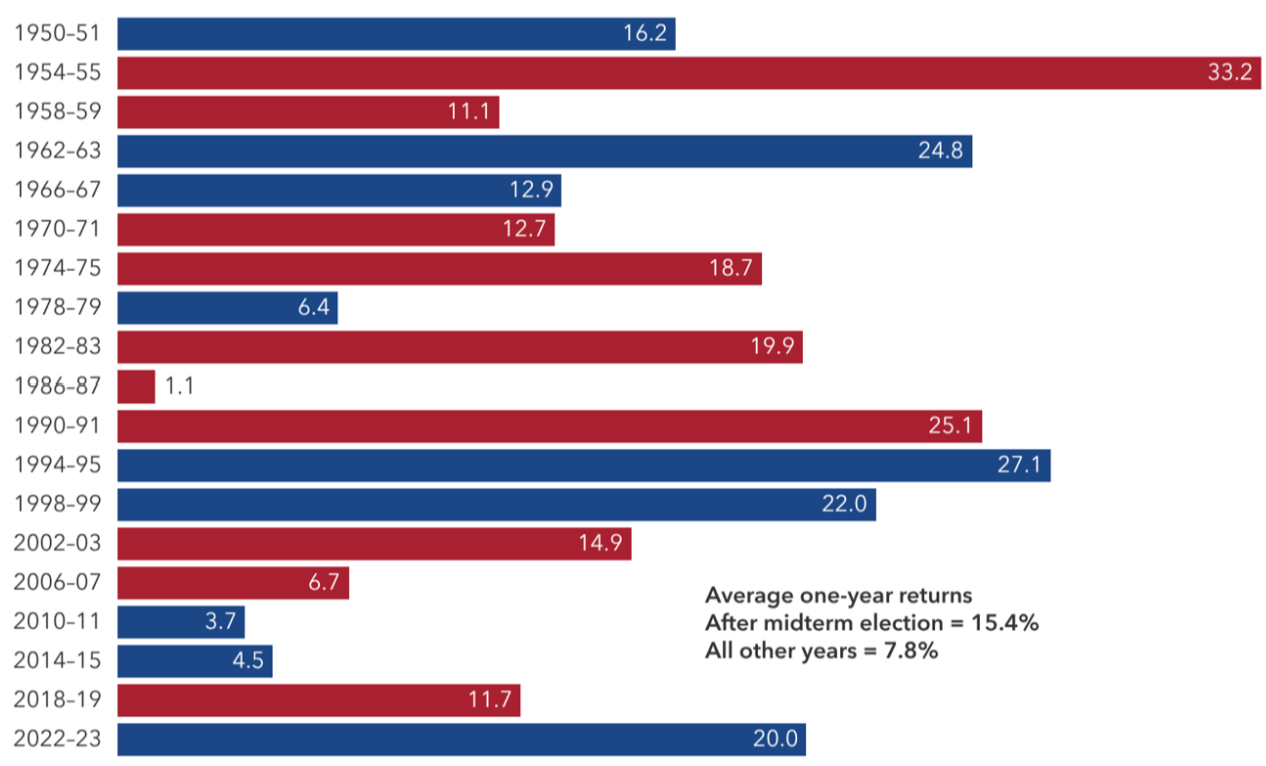
Volatility is common around midterm elections, typically peaking about a month beforehand. What follows, however, has historically been strong: since 1950, the S&P 500 has never declined in the 12 months following a midterm election, and its average one-year return after midterms has been 15.4%, nearly double its 7.8% average over all other years.
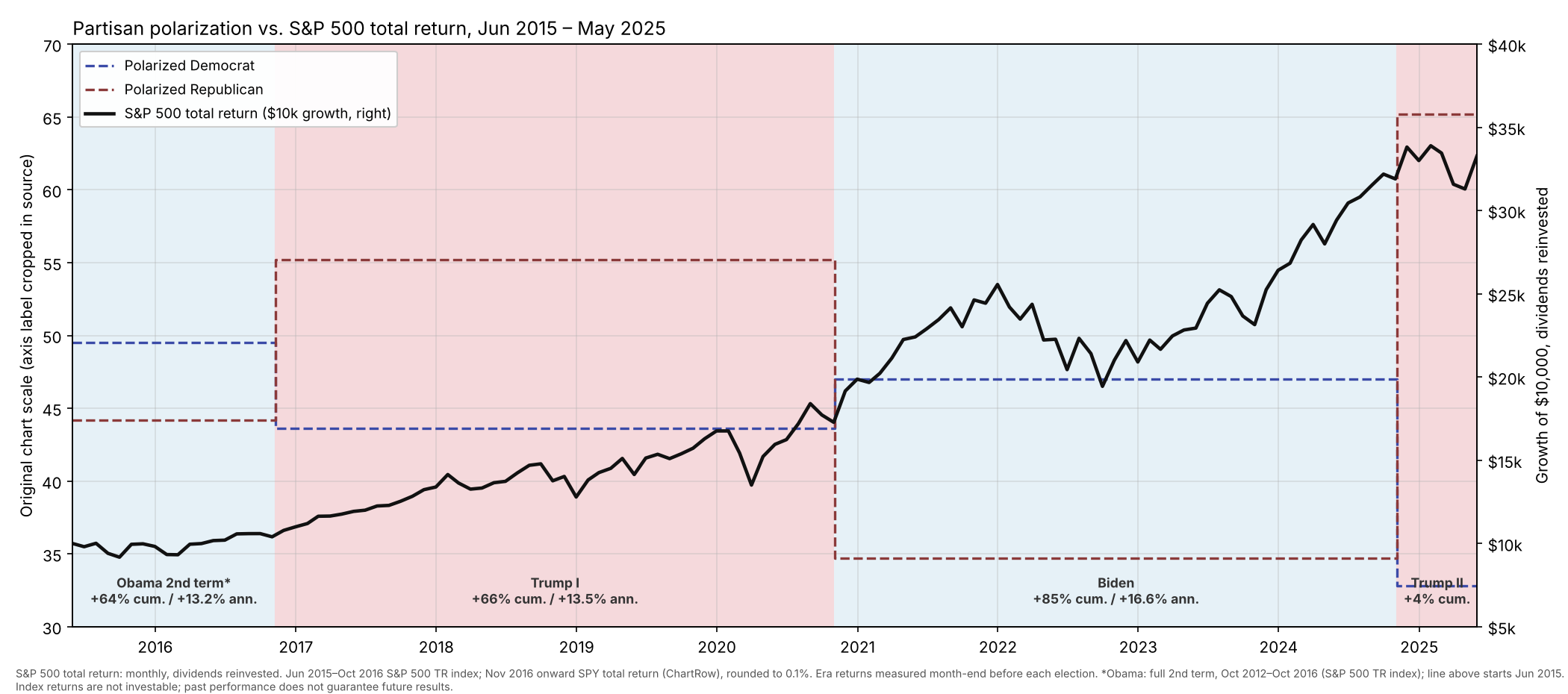
Of course, staying calm is easier said than done when politics is involved. In a recent Wall Street Journal article titled "Don't Let Politics Poison Your Portfolio," personal finance columnist Jason Zweig cites a paper by University of Arizona finance professor Rick Sias and colleagues that surveyed more than 12,000 Americans from 2015 to 2025. The research shows how people's expectations for stock market gains over the next 12 months shift with their political affiliation.
Not surprisingly, Democrats' outlook dipped after Trump's election in 2016, while Republicans stayed optimistic throughout. Yet despite pandemic-driven volatility, that term still delivered positive returns overall.
After Biden's election, the pattern flipped: the share of Republicans expecting stocks to rise over the next 12 months fell from about 55% to about 35%. Like any four-year stretch, his term had its share of volatility, including the war in Ukraine. Yet those four years produced some of the strongest calendar-year stock market returns in modern history.
Now the pattern is repeating. During Trump's second term, Democrats' optimism has fallen from just over 45% to below 35%, while the share of Republicans expecting gains has climbed to 65%.
The lesson is simple: Don't let political views and biases drive your investment decisions. As Mr. Zweig puts it, share your political views at the polling station, or by shouting at a relative over Thanksgiving dinner, but leave politics out of your portfolio. And if we can all agree on that, we can move on to the main course this Thanksgiving: the potential benefits of a divided government.
Divide and Conquer
A divided government has historically been a feast for investors. But it's not all gravy, so I'll break down the tailwinds and headwinds of a divided government.
Tailwinds:
A split Congress has generally been good for the stock market because it can reduce uncertainty. Consider how tariff rhetoric, or the ability to wage war without checks and balances, can destabilize markets. History supports this: since the 1880s, 14 midterm elections have produced a divided government under a Republican president. That is the most common outcome and a distinct possibility again this year. In those cases, the stock market averaged an 18% return over the following 12 months, even better than the 14% average after all midterms over that period, and was positive 93% of the time.
A divided Congress also provides a check on unilateral decisions, including military action against a country like Iran. We’ve already seen how such action destabilizes energy prices, commodity prices, and inflation, pushing interest rates higher. Increased military spending also adds to the deficit.
A divided Congress can also act as a brake on fiscal excess. Aggressive tax cuts and spending can boost the economy and stock market in the short run, but often at the expense of growth and returns later. The One Big Beautiful Bill Act’s tax cuts were justified in part by anticipated tariff revenue. I won’t argue whether that was a good or bad decision.
Now the bill has come due. After a lengthy legal battle, the Supreme Court ruled that the International Emergency Economic Powers Act (IEEPA) does not authorize tariffs, meaning the administration lacked the authority to impose them. Roughly $166B in collected tariffs is now being refunded to importers, and replacement tariffs have recouped only part of the lost revenue. Because the tax cuts were justified partly by that revenue, the ruling leaves a gaping hole in the budget, one the Congressional Budget Office estimates will add more than $1 trillion to the deficit over the next decade.
Part of that risk is already reflected in higher interest rates, as Treasury investors demand more compensation for holding U.S. debt. And as rates rise, interest expense consumes a growing share of the government’s annual spending.
Interest expense and mandatory spending (Social Security, Medicare, Medicaid, and other programs required by law) already consume nearly all federal tax revenue, and that share is projected to keep rising. Discretionary spending on infrastructure, education, and even defense must increasingly be funded with additional borrowing, driving interest costs even higher. It’s easy to see how this could spiral out of control.
Meanwhile, trading partners and allies, with whom relationships were built over decades, have been striking long-term agreements with other countries. That reflects concern about our reliability as a partner. It also shifts investment away from the U.S. and disrupts supply chains, adding further inflationary pressure. Greater checks and balances could help slow that erosion.
Headwinds:
On the other hand, a divided Congress could slow the market-friendly parts of the administration’s agenda, such as cutting red tape, pursuing broad deregulatory reform, and reducing taxes to boost corporate profits. It can also create noise whenever the two parties must negotiate on the budget or the debt ceiling, including the possibility (or should I say the likelihood) of a government shutdown.
Additional Medicaid spending, whatever its merits, could also add to the deficit, a risk I don’t want to dismiss. Finally, greater compliance pressure on CEOs and corporations can raise costs, reduce profits, and lower the price investors are willing to pay for those profits.
Net-Net:
Weighing these factors, investors appear to see the benefits of checks and balances outweighing the drawbacks for one main reason: less uncertainty. Volatility can undermine bull markets, while greater clarity on the legislative agenda gives investors a reason to stay invested and gives companies a clearer path to execute their business plans.
Don’t let political bias poison your portfolio.
Whatever happens on Election Day, the biggest risk to your portfolio isn't who wins. It's letting politics, rather than your plan, call the shots. Markets have rewarded patient investors under both parties; what they rarely reward is going all in or all out based on a ballot.
So this Thanksgiving, save the debates for the dinner table and let your plan do the heavy lifting. After all, building wealth isn't about winning arguments. It's about buying back your time, and that's the uplifting topic I'll save for the next newsletter😉
Noble Wealth Pro Tip of the Month
Year-End Planning
Only two months remain in 2026, which means there’s still time to take advantage of year-end planning opportunities. As I do each year, I’ve put together a few worth reviewing.
Harvesting Income at Favorable Tax Rates
I’ll start with one of the most commonly overlooked opportunities I see among clients: recognizing additional income at favorable tax rates. Paying some tax today can sometimes reduce your total tax bill over the life of your financial plan.
For 2026, single filers with taxable income below $49.45K, or married couples filing jointly below $98.9K, may have room to realize long-term capital gains at a 0% federal rate. If you own appreciated securities in a taxable account, this could be an opportunity to increase your cost basis without paying federal capital gains tax. Keep in mind that the gains themselves count toward those thresholds, so the amount you realize matters.
Another option is to fill the 12% ordinary income tax bracket through Roth conversions or by switching employer 401(k) contributions from pre-tax to Roth. That bracket ends at taxable income of $50.4K for single filers and $100.8K for married couples filing jointly. These strategies need to be coordinated, since additional ordinary income can reduce the room available for capital gains taxed at 0%.
The potential savings can be meaningful. Realizing gains at 0% instead of a future 15% rate saves 15 percentage points on those gains. Similarly, paying 12% on a Roth conversion today rather than 22% on a future withdrawal creates a 10-percentage-point difference.
The opportunity isn’t limited to lower tax brackets. Single filers with taxable income between approximately $105.7K and $201.8K, and married couples filing jointly between approximately $211.4K and $403.6K, fall within the 24% bracket. Recognizing additional income within that bracket may make sense if those dollars would otherwise be taxed at 32% or higher in the future.
Watching Medicare Premium Surcharges
Those enrolled in Medicare, or expecting to enroll in 2028, should also monitor their income. Medicare generally uses income from two years earlier to determine income-related premium surcharges, so 2026 income will generally affect 2028 premiums. The 2028 thresholds haven’t been announced yet; for reference, 2026 premiums use thresholds of $109K for single filers and $218K for joint filers. Crossing a surcharge threshold can make even a small amount of additional income surprisingly expensive.
Watching Premium Tax Credits
Anyone receiving premium tax credits for health insurance purchased through the exchange should review their projected household income. Additional income can reduce eligibility and trigger repayment. Beginning in 2026, repayment caps have been eliminated, so any excess advance premium tax credits must be repaid in full.
Exercising Incentive Stock Options
If you have incentive stock options, you may be able to exercise some without increasing your current federal income tax liability. Unlike non-qualified stock options, exercising incentive stock options generally doesn’t create ordinary taxable income at exercise. However, the difference between the exercise price and the stock’s market value generally counts toward alternative minimum taxable income if you hold the shares beyond year-end.
The key comparison is between your tentative minimum tax and your regular tax liability, not between the two income figures. A tax projection can help determine how much you could exercise before triggering additional AMT. Keep in mind that the eventual sale of the shares has separate tax consequences.
Small Business Retirement Plans
Finally, business owners should review whether establishing or contributing to a small business retirement plan could provide additional tax-advantaged savings. Setup and contribution deadlines vary by plan, so it’s worth starting that discussion now.
Each situation is different, and these strategies can affect one another. Review any potential changes with your advisor or tax professional before moving forward. As always, reach out if you have any questions.
If you're curious about this proprietary tool, it's available to the public. Feel free to check it out at www.noblewealth.io/goals-based.