NWP Monthly Digest | July 2026
There's a lot to celebrate heading into the Fourth this weekend. The World Cup is back on American soil for the first time since 1994, with the U.S. playing again tonight in the Round of 32; Wimbledon is underway for the tennis fans among us; and the economy is humming right along.
But one thing will be missing this year. I grew up in Steamboat Springs, Colorado, and the Fourth of July is nostalgic for me, as it has always been one of the best days of the year. Every summer, family and friends would gather on my mom's back porch to watch the fireworks show — the same people, the same porch, year after year. But those days are a distant memory. Her home has since been sold, and the fireworks show will no longer be held anyway due to “severe drought and wildfire risks.” Instead, the town has tried to fill the void with light or drone shows. Yet there's no replacement for the world's largest firework, which Steamboat set off in 2020.
Which has me asking a bigger question heading into our 250th: is America still the biggest firework in the world, or is the country destined to become a light show, its booming years behind it?
We'll come back to it. First, though, the month behind us — because it delivered some fireworks of its own.
Let's start where most of you are probably looking anyway: the market. The S&P 500 just closed out a tremendous quarter, up nearly 14% since the end of March. But the real fireworks came from a rocket company whose valuation literally left the stratosphere. I'm talking, of course, about SpaceX — which just wrapped up the biggest IPO in history and now carries a valuation north of $2 trillion.
I also want to take a moment for Alan Greenspan, who passed away last week at 100. The second-longest-serving Fed chairman, he spent nearly two decades guarding the institution's credibility and independence — the kind of quiet work a country only notices once it's gone. Which, this month of all months, has me thinking about what holds a nation together, and how long it lasts.
‘Merica 250
This Fourth of July, we mark America's 250th anniversary of signing the Declaration of Independence. And boy, have we come a long way — from about 2.5 million people to roughly 350 million, and from a fledgling republic to the dominant power on the planet. Which makes the “how long does it last” question less abstract than it sounds.
In 2022, I read a book by Ray Dalio, one of the most successful investors, about the changing world order (Principles for Dealing with the Changing World Order), analyzing the historical cycles in which superpowers rise and decline, such as the Dutch and British Empires. (Here's a video Mr. Dalio posted on the subject, if you're interested.)
Boiled down, the common traits superpowers exhibit before their fall are:
Growing wealth inequality
Becoming increasingly politically divided
Accumulating excessive debt
Losing competitiveness in education
Facing external rivalry from a rising great power
The question isn't whether we've put on a good show for the past 250 years. It's whether we can keep doing it.
What Makes America Great?
The U.S. created a system where individual ambition could be converted into economic value on an unusually large scale.
Anyone in this great country can dream big. And I'll admit that some have a head start and can risk their capital more freely than others. But that doesn't change the fact that the foundation we've built over the last 250 years lets almost anyone — the talented, the hardworking, the shrewd, or even just the plain lucky — accomplish nearly anything.
Case in point, look no further than Elon Musk. Regardless of how you may feel about him personally, he has used the American system to become one of the greatest entrepreneurs of our time, widely credited with driving American technological advancement in the 21st century.
That same system is what let Greenspan spend eighteen and a half years keeping the Federal Reserve credible and independent enough that entrepreneurs like Musk could take enormous risks and trust the rules wouldn't change on them. The booming economy is the firework. Greenspan spent a career on the far less visible job — making the conditions safe enough for it to go off without blowing up in our faces. You need both.
And as we know, this has led to unrivaled success and wealth. The SpaceX IPO last month officially made Musk the world's first trillionaire. A mind-blowing figure — but herein lies one of the key risks for America over the next 250 years.
Potential Obstacles to Greatness
Here's the uncomfortable part: the United States isn't immune to a single one of the common traits Dalio lays out for a declining empire. All five have grown more visible over the last decade. A wealth gap that keeps widening. Political polarization that needs no introduction. A mountain of public debt, and an annual deficit that gets harder to service every year. Declining investment in education and slipping international rankings. And a rising rival in China, closing the economic gap faster than anyone predicted a generation ago. Together, left to intensify, they're the pattern that has toppled great powers before.
But that's the country's problem, and you didn't come here for a geopolitics lecture. Here's the part that's actually yours: every one of these has a personal version, and this is the one you can do something about. If there's a single thing to take from this section, it's that — try not to get in your own way.
Ignore the Gap
When you step back and realize just how much $1 trillion is, it's hard to fathom how one person could be so wealthy. Does anyone really deserve that much wealth? I don't have a clean answer to that one, but plenty of people are asking it in earnest. And when millions are struggling to put food on the table, it's naturally going to create some hostility. But the trap isn't the size of anyone else's pile — it's what resenting it does to your own decisions. Dwelling on this can be counterproductive, even if it's true. Focusing instead on the tailwinds this country has created for you is a much better recipe for success.
Not Everything Is Polarized
You can't lower the national temperature single-handedly, but you can refuse to run hot yourself. The next time someone across the aisle says something that makes your blood pressure spike, try treating it as a question instead of an attack. More often than not, you'll find you agree on more than the shouting suggests — and the handful of times you don't, you'll at least understand why. Neither of those outcomes is available to the person who already decided the other side is the enemy.
Watch Your Own Leverage
Empires borrow against a future they assume will keep growing, right up until it doesn't. People do the exact same thing through lifestyle creep: a bigger house, a bigger car payment, a bigger number that has to show up every month whether the market cooperates or not. The clients I worry about least aren't the ones with the biggest net worth. They're the ones whose spending never grew as fast as their income did.
Learn as Much as You Can
Empires slip when they stop out-educating their rivals. You can't fix the nation's classrooms by yourself, but there's a personal version of this you control completely: whether you keep learning after the diploma is framed and hung on the wall. Most people quietly stop. The ones who don't tend to be the ones still standing when the ground shifts.
My uncle, who is a professor of economics back East, once told me:
“Take the job where you will learn the most, not the one that pays the most.”
That advice resonated with me in 2014 when I left J.P. Morgan. I have to admit, it was pretty lucrative, but I have never once regretted that decision, which is why I find myself writing to you today.
How Do You Deal With External Rivalry?
While Dalio refers to China when discussing external rivalry, in your career the focus is really on AI. These days, it’s almost impossible to write without acknowledging AI—the elephant in the room. So, I’ll give it the attention it deserves.
Ask any recent college graduate: landing an entry-level job has never been harder. Why would a company spend the time and money to train someone up when AI can already do much of that work, faster and cheaper? So graduates get stuck in a catch-22. They need experience to be worth hiring, but nobody wants to hire them long enough to get it.
Frankly, any employee who isn't adding enough value to justify their cost is at risk of losing their job. State Farm just rewrote the contracts for all 19,000 of its independent agents — cutting pay and benefits and requiring them to adopt new AI tools, with some agents facing up to a 40% earnings cut if they want to stay. It reinforces the narrative that if you're not adding value to the overall sales process or customer experience, and your job is primarily answering questions, your position or compensation is at risk. Plain and simple.
But the implications go beyond that. Over the weekend, I was reading about how nonfiction how-to books are becoming obsolete. Which makes sense. Perhaps that's why the Personal Finance For Dummies book in my library never got opened😉. Side note - I actually keep a copy on my bookshelf for Zoom calls to see if anyone notices.
But seriously, if you’re not adding value above and beyond your compensation, and AI has the potential to take over your day-to-day responsibilities, think about your options before your job becomes obsolete.
There’s a Silver Lining…
American capitalism has created a foundation where you can control your path to success, and AI will not hinder that path if it is distinctly human: adaptable, capable of making human judgments and even human mistakes, rather than being purely formulaic, with the ability to alter plans and navigate whatever life throws at you.
AI can run a beautiful, polished light show. It can't set off a firework — that still takes a person willing to risk it.
One example of a distinctly human path starts back in 2018, when two handsome gentlemen with full heads of hair met for coffee to discuss business strategies. Little did we know that one thing would lead to another, and we'd discover not only that our businesses were the same size, but also that we shared a common goal of building a unique advisor practice structured to best serve our clients.
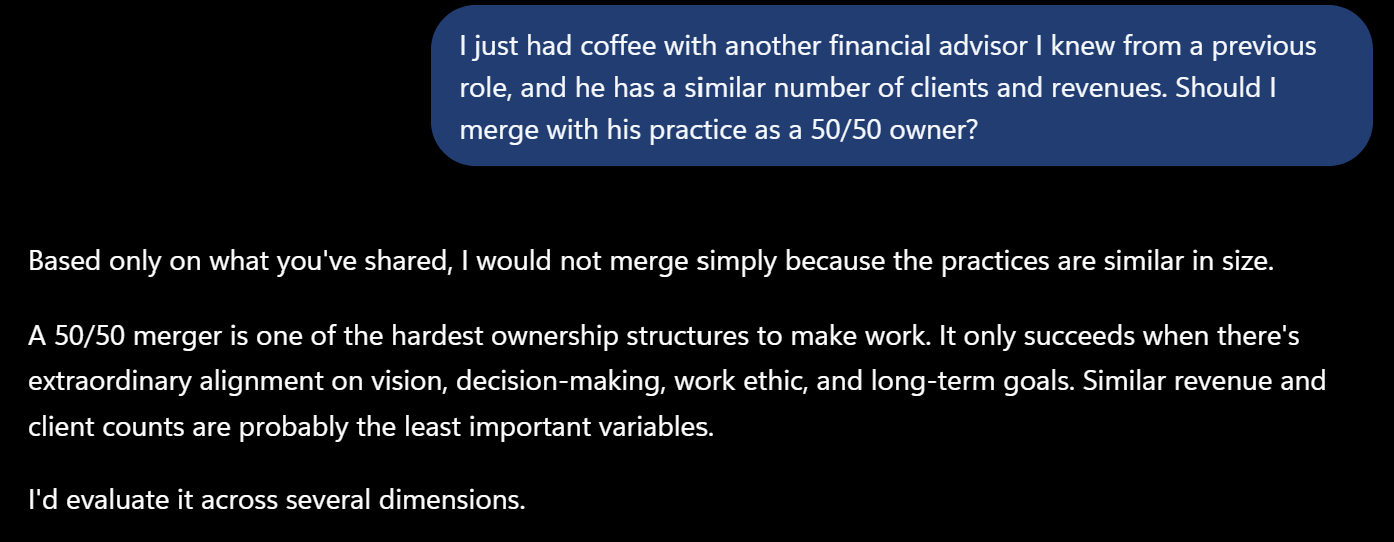
About a month later, we took a leap of faith and merged practices as equal 50-50 owners. Fellow business owners questioned the decision—what if there’s a disagreement? Who gets the tiebreaking vote? We weren’t worried. Our interests were aligned, we trusted each other, our strengths complemented one another, and we were stronger as a team than on our own. Eight years on, I can confidently say it couldn’t have turned out better. Admittedly, it was a very human decision, and just for grins, I asked ChatGPT what it thought about the idea…
Last month my family and I caught a one-of-a-kind show at Red Rocks: a toddler rave. Yes, a toddler rave put on by a DJ named Lenny Pearce — whether this was his original plan or out of necessity, as the hill to climb to compete with a million other talented musicians was too steep — decided to corner the toddler market. The music was, I'll be honest, terrible. But our kids had a blast, and because of that, so did we. It’s really quite impressive. He sold out Red Rocks, and that rocks🤘
AI won't hand you a path like that. Only you can, and it only has to work for you.
Steamboat won't be lighting up the sky this weekend, and the porch I watched it from belongs to someone else now. Some fireworks you don't get back.
American exceptionalism, built on ambition, risk-taking, and innovation, will determine whether we continue to light up the sky over the next 250 years as we have in the past, or whether the tenets Dalio warns about prove too great, leaving us with an uneventful light show instead. I believe that choice is still ours to make, just as it has been since 1776.
And with that, there's no reason the American firework can't keep going off for another 250 years. I intend to spend this Fourth betting that it will.
Happy 250th to you and your family🎆
Noble Wealth Pro Tip of the Month
Trump Accounts
Any parents with a child born in 2025 can set up what is referred to as a Trump Account to receive $1,000 from the government in this tax-deferred account. Those who have already started the process at TrumpAccounts.gov will officially be able to open the account on Independence Day, at least based on what's being reported for now.
While these accounts come with complex tax codes and nuances, they’re essentially free money, and anyone eligible should take advantage of them.
Increase Your Automated Savings as Your Income Grows
Most people have automated contributions set up in their retirement accounts, like a 401(k). But it's less common that individuals automate savings into a taxable investment account. But if the excess cash after all expenses have been paid and other savings have been made in your group plan are directed to a taxable account on a monthly basis, individuals can really move the needle when it comes to reducing lifestyle creep, because it's harder to spend money when you don't see it in your bank account.
But this isn't a set-it-and-forget-it strategy. Naturally, as your income grows with promotions, tenure, you name it, your excess cash flow, or your ability to save, likely grows as well. So it's important that, at least on an annual basis, you're making modifications to this automated amount.
If you don't have time to figure out what that automated amount is, perhaps you can stay true to a savings target as a percentage of your gross income. If you start by saving 10% of your gross income into a taxable investment account, and your income increases by $50K, naturally that automated savings amount should go up by $5K on an annual basis.
Over time, this habit can be far more powerful than trying to save more through willpower alone. Your future self won't remember what you spent that extra money on—but you'll certainly appreciate the wealth it helped create.
What Student Loan Borrowers Need to Know
With student loan debt now at $1.7 trillion, many parents and students are trying to do their best to minimize debt and ensure these loans are repaid in an effective manner. But that's not all. Effective next week, there are new rules for the borrowing limits and repayment options. Here are some of the changes that are going to take effect:
Parents used to be able to borrow up to the full cost of their child's undergraduate education. Now, borrowing is capped at $20K per year per child, or $65K total.
There is also now only one repayment option for Parent PLUS loans, instead of the several plans parents could previously choose from. To help make monthly payments more manageable, the new Tiered Standard Plan stretches out payments over 10 to 25 years, depending on the size of the balance.
Parents are also no longer eligible for Public Service Loan Forgiveness.
There are no changes to the annual borrowing limits for graduate school, as it's still $20,500 per year, but now that's capped at a total of $100K over the course of a degree, down from about $139K.
For law and medical degrees, the cap has been raised to $50K annually or $200K total.
The Education Department also wants to change what counts as a professional degree and remove the designation for nursing, accounting, and other degrees. That change is pending litigation.
For undergraduates, those who are still dependent on their parents can take out $5,500 for their first year and a bit more in subsequent years, for a total of $31K. Independent undergraduates can take out $9,500 in the first year and up to $57,500 total.
With the Tiered Standard Plan, monthly payments will now be spread between 10 and 25 years, depending on the size of the balance. With the Repayment Assistance Plan, monthly payments are based on income and the time borrowers start repayment. It requires 30 years of monthly payments before the debt can be forgiven, which makes this a very high hurdle.
If you are an undergraduate and already have federal student loans, you have until June 2028 to switch to one of the new options, but you'll still be able to use the old repayment plans in the meantime. This is outside of the Saving on a Valuable Education (SAVE) Plan, which is a Biden-era plan where anyone making payments using that plan now has only 90 days to switch to one of the new options.